

[ad_1]
Latin American crime rates are triple the world average and centuries of art can be found throughout the region, often unprotected or with minimal security. Crimes related to high value art and antiquities often involve cunning schemes and intriguing news reports.
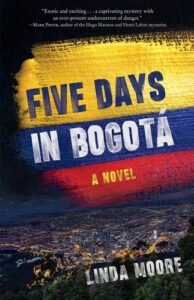
The abundance of pre-Columbian sites potentially well-stocked with artifacts make them a rich target for looters. In the novel Five Days in Bogotá, fictional looters offer Ally an abundance of artifacts from sites in Northern Colombia. The absence or lack effective on-site security allows easy plundering. Governments and anthropologists are discovering sites with digital tools like drones with Lidar. Dealers in illegal artifacts also use these tools to explore remote areas with difficult access. Networks of looters and their sponsors have created a criminal web where artifacts disappear into private hands for resell to collectors or legitimate buyers like museums who can authenticate these objects but not their provenance.
I visited a collector in Lima whose collection covered the walls and ceilings of his home and spread to a walk-in vault installed in a back building. The collection included colonial paintings from the 1600-1700s, a solid silver altar from a Catholic church, a necklace made of twenty real-sized gold peanuts from the Tombs of Sipan discovered in 1988 and much more. The collector claimed it was legal to pay site looters if the objects did not leave Peru. This astonishing accumulation had to involve more than a Peruvian who loved his country’s cultural history.
Colonial-era objects are vulnerable for similar reasons. Isolated churches and monasteries abandoned or little used for centuries become easy targets. In 2000, the San Diego Museum of Art purchased Expulsion from the Garden of Eden (1728) from a Mexican dealer for $45,000. When museum curators discovered a listing identifying the painting that had been cut from its frame and stolen from a remote church in the state of Hidalgo, they returned it to the Mexican government for an investigation. Approximately 600,000 works in Mexico alone have been registered which allows experts to determine ownership, but just as many or more are not listed for Mexico alone. Imagine the art treasure trove in Latin America.
The forgery market in Latin America began in Mexico in the 1800s when pre-Columbian objects were purchased by American and European museums anxious to have encyclopedic collections from exotic places including the Americas. Acquisition specialists had little scholarly research to authenticate objects. Today many fakes can be found in important museum collections. They are more easily spotted when compared to works that came directly from legitimate archeological digs. Looters will take broken pieces of little value and form new parts to fake a highly valued object. Scientific tools like chemical and soil tests, carbon dating, and radiography as described in my novel Attribution have made it much more difficult to create fakes.
Contemporary Latin American art forgeries abound as auction values increase. Forgers have an additional challenge when living artists can identify their own work. In 1993 Christie’s auction house withdrew a Fernando Botero painting offered at $500,000 because it was discovered to be a fake. It was particularly embarrassing because Christie’s put the fake work on the cover of their sale catalogue and the owner of the real painting protested. Botero confirmed the auction painting was a fake. At that time, the artist received queries about three to four paintings per month; he declared all were fakes! Botero died in 2023 and experts will need to authenticate works without his help.
Auction catalogues contain warnings for the buyer to beware. Buyers must have their own experts for authentication, but most works are not available for thorough inspection pre-sale. The big houses do provide authenticity warranties, but the small print includes clauses about accepted attributions and expert opinions. In a world where many experts can’t agree, how can the average collector be certain of what they are buying?
In Latin America’s high crime environment, sophisticated crime organizations pump up art auction sale prices to launder money. Little known artists can quickly fetch top dollar bids, sometimes in the millions. The centuries-old tradition of anonymous buyers and sellers facilitates these schemes. European countries have worked hard to implement regulations for dealers to know their buyers and report cash transactions. The U.S. recently instituted similar regulations. With over $60 billion in annual international art sales, it will be difficult to enforce especially because dealers and gallerists are ill-equipped to comply.
At an art fair, a collector presented me with a briefcase full of cash to purchase an expensive French painting. U.S. banks require a mountain of paperwork for any cash deposit over $10,000. The collector declined other payment options like a wire transfer from his account to mine or another bank instrument, a tip-off the transaction was shady. I passed on the deal.
Bank failures, wild inflation, and governments trying to stabilize their national currency, converting cash into hard assets like gold, jewelry, and art is common among the wealthy in Latin America. I attended a luncheon in Mexico City where a fellow guest admired the golden chandelier. Our host corrected him. The chandelier was pure gold, he laughed, and a crate was ready to ship it wherever the owners needed to flee. Worth approximately $60 million U.S. dollars, it’s not likely any customs officer would guess its value.
Free zone warehouses (FTZ) in Europe, Asia and the U.S. have museum-level climate controls and security protections. Used as a strategy to avoid capital gains taxes and duties, art works can be bought, sold, and traded without ever leaving the FTZ. Illicit transactions are converted into multiple legal transactions complete with provenance and appraisal paperwork. These warehouses, said to be the largest unseen museums in the world, contain an estimated 1.2 million artworks. Compare that to the Louvre with 380,000 works for a sense of the scope of the problem.
Latin American art crimes share similarities with other regions of the world, but the volume of stolen or forged material, illicit cash and corrupt or non-existent enforcement agencies amplify the attraction as a setting for crime fiction. A news story, perhaps true or not, about Escobar’s men freezing without firewood in a mountain hideout burning piles of cash to stay warm, says it all.
***
[ad_2]
Source link