
[ad_1]
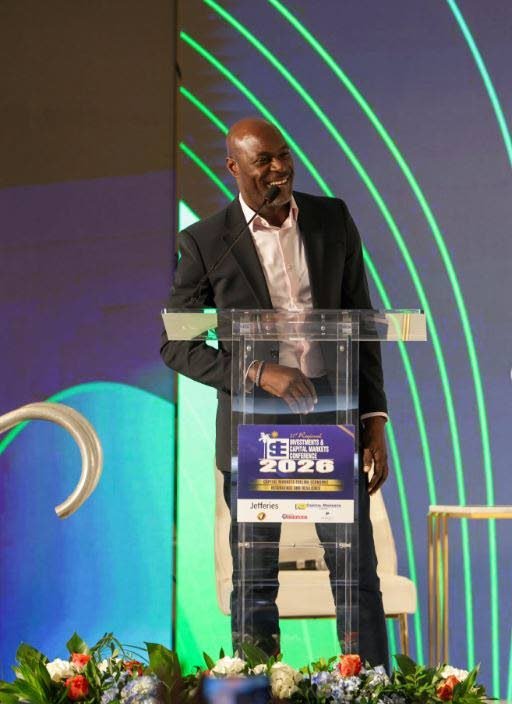
Sygnus Group CEO Berisford Grey calls for more pension funds to participate in alternative investments.
PENSION funds across the Caribbean are being urged to take a more active role in financing the region’s growth by allocating a greater share of their assets to alternative investments. The call comes as traditional funding channels fall short of the capital needed for infrastructure, climate resilience and long-term development.
“There need to be deliberate strategies from investors such as pension funds to put money in alternative investment,” said Sygnus Group CEO Berisford Grey Speaking at the Jamaica Stock Exchange (JSE) Investments and Capital Markets Conference on Thursday.
Berisford Grey noted that allocations to alternative investments by pension funds and institutional investors have been growing significantly in advanced markets. In the United States and Europe, alternative investments account for roughly 10 to 15 per cent of gross domestic product (GDP), channelling capital into infrastructure and other long-term assets that deliver stable returns with lower volatility. However, even modest progress could have a meaningful impact.
“If we grow the market to three or five per cent of GDP, that is close to $20 billion of mobilised, flexible capital in the economy, which will have a huge multiplier effect across the region,” he said.
For Jamaica, an economy valued at roughly $20 billion, developing a stronger alternative investment space, where capital flows into areas such as real estate and private equity, could unlock US$8 billion or more in risk capital to help drive infrastructure development. The push for alternative investments comes as the region faces rising financing needs. Infrastructure investment requirements over the next five to 10 years are estimated at about $21 billion, a figure that has increased following Hurricane Melissa, while climate resilience and adaptation needs are estimated at approximately $55 billion according to Grey. Alternative investments, which typically sit outside traditional bank lending and public capital markets, include private credit, infrastructure assets and other instruments that allow for flexible and customised financing structures.
“There is a big appetite and a level of consciousness globally as we move away from fossil fuels to renewable energy, even though, honestly, I’d like Jamaica to find some fossil,” Grey said.
While global investment attention has increasingly turned to artificial intelligence, with nearly $50 billion already invested worldwide, he noted that the more immediate opportunity for the Caribbean lies in the energy transition, with renewable energy projects being an area where alternative investments could have a strong multiplier effect, given the region’s ambitious renewable targets. However, early-stage risks often deter traditional lenders, making alternative capital critical for feasibility studies, equity injections, and project development.
“There is no pension fund in the region that has said, ‘Let me invest in a solar farm under a 20-year power purchase agreement that gives predictable cash flow for 20 years,’” Grey said. “But pension funds should be owning those assets.”
Globally, pension funds routinely co-own long-term infrastructure assets such as airports and highways, investments widely viewed as low-risk, cash-generating assets that align well with pension fund liabilities. These are assets that are proven to generate excellent cash flows over long periods of time, and Grey is urging pension fund managers to move past perceived constraints around large-scale projects as the region needs to invest in what he classifies as “big themes”; these are resilience, climate and infrastructure, as those are the binding constraints affecting the region today and will continue to in the future if the region doesn’t mobilise capital into those areas.

GREY…there is no pension fund in the region that has said, ‘Let me invest in a solar farm under a 20-year power purchase agreement that gives predictable cash flow for 20 years’.
[ad_2]
Source link