
[ad_1]
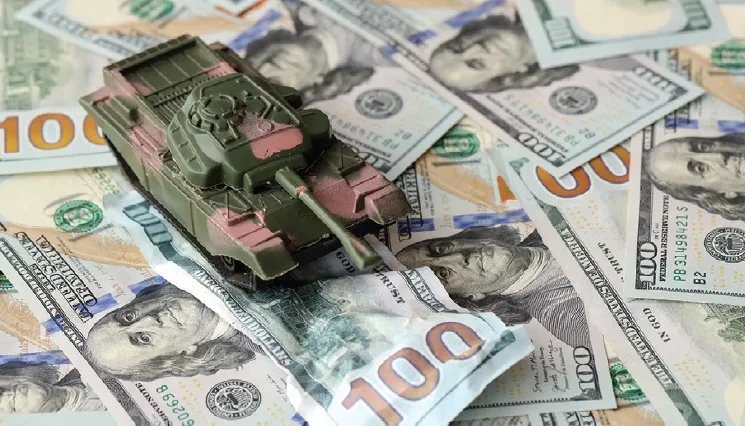
In a world plagued by pressing issues like sustainability, global warming, and climate change, where surface temperature has already risen by nearly one degree Celsius, where concerned citizens are suing their government for not doing enough to save environment, where meetings like COP28, Paris declaration, the countries are promising to reduce the carbon footprint, in the same world the global community witnessed a stark dichotomy in investment priorities as the United States Senate approved a $91 billion aid package for war and weapons efforts, for Ukraine, Israel Taiwan and several other countries in contrasting sharply with the commitment of eleven developed countries pledging only $11 billion towards global development initiatives.
In today’s world, there is a big problem with taking care of the environment and stopping climate change. Global leaders are deciding where to spend money, and it is worrying. The Earth is getting hotter, with 2023 being one of the hottest years on record. Every month in 2023 was among the top 7 hottest months ever recorded. In fact, from June to December, each month was the hottest on record. In July, August, and September, global temperatures were more than 1.0°C above the long-term average—the first time this has happened. People are even suing their governments for not protecting the environment well enough.
Just last week, India’s Supreme Court made a really important decision. They said that everyone has the right to be protected from the bad effects of climate change. This is a big deal because it means the environment is linked to our rights as people. It is a step towards making sure we all have a healthy planet to live on.
And in Switzerland, another big decision was made. The European Court of Human Rights said that governments must do more to fight climate change. They said Switzerland was not doing enough to protect its people from climate change. This is a big deal because it means governments might have to change their ways to keep people safe from things like extreme weather.
Even though international agreements are saying we need to reduce pollution, still some countries are doing the reverse, spending a lot of money on weapons instead of helping the environment.
For example, The United States Senate has given a massive $95 billion aid package aimed at assisting Ukraine, Israel, and Taiwan. This is a lot of money! The package prioritises bolstering Ukraine’s defence against Russia, with plans for swift delivery of new weapons to the country. Aside from military assistance to Ukraine, the aid package includes financial aid for Israel, as well as humanitarian assistance for regions like Gaza and Sudan. Additionally, there are provisions for military support to Taiwan.
The approval of this aid package follows intense debates among lawmakers, reflecting differing views and concerns. However, the decision signals a commitment to existing geopolitical interests and ongoing military engagements over environmental concerns.
Critics argue that the emphasis on military aid perpetuates a cycle of violence and instability, potentially exacerbating global challenges such as climate change and natural disasters.
At the same time, a group of eleven rich countries only promised $11 billion to help with important projects to protect the environment around the world. These new plans want to help countries get loans for projects, especially ones about the environment and making things better for the future. The size of this investment pales in comparison to the vast sums allocated for war, raising questions about the global prioritisation of resources.
The head of the World Bank Group, Ajay Banga, thinks these plans will help many people, and it shows that countries are willing to help with global development. The World Bank Group hopes that the $11 billion can become even more money to help save the Earth instead of using it for wars and fighting. This is just a small amount compared to what is needed to protect the Earth. It is like saying you will fix a big problem with just a tiny band-aid.
At important global meetings like the UNDP, G7 and G20 Expert Group, they are asking for trillions of dollars to fix problems like poverty and climate change. They want countries to work together to make things better for everyone. On the other hand, wars and fights only make things worse, causing people to move, causing more poverty, and spreading sickness and diseases.
This discrepancy in investment underscores a troubling trend: a disproportionate allocation of resources towards perpetuating conflict and warfare rather than safeguarding the planet and ensuring a sustainable future for generations to come.
To illustrate further, consider the impact of redirecting even a fraction of the funds allocated to military endeavours towards renewable energy research, reforestation projects, or climate resilience initiatives. Such investments could yield tangible benefits in combating climate change, preserving biodiversity, and fostering global cooperation towards a shared environmental vision.
In this critical juncture of recent human history, where the fate of our planet hangs in the balance, we must reassess our priorities and allocate resources in alignment with the urgent challenges we face. Only through collective action and a concerted shift in investment towards sustainability and environmental stewardship can we hope to address the pressing issues that threaten the very fabric of our existence.
By investing in innovative financial instruments aimed at addressing climate change and other pressing issues, the countries will send a message of changes that are needed in the mindset, and loud thinking and bring trust for solutions through peace and departure from militaristic approaches.
The disparity in investment priorities between war and global development initiatives is reflective of broader systemic issues, including geopolitical power dynamics, vested interests, and the influence of the military-industrial complex.
The perpetuation of conflict serves the interests of certain stakeholders while neglecting the broader imperative for peace, sustainability, and equitable development. Moreover, the environmental and humanitarian costs of war are often overlooked, exacerbating global challenges such as climate change and displacement.
In conclusion, the allocation of $91 billion for war efforts, juxtaposed with $11 billion for global development initiatives, accentuates a fundamental misalignment in global priorities. While the former perpetuates a cycle of violence and instability, the latter represents a modest step towards addressing pressing international humanitarian issues. However, to truly remedy this imbalance, a paradigm shift is necessary—one that prioritises diplomacy over militarism, cooperation over conflict, and sustainability over short-term gains.
To address this disparity, several remedial actions are imperative. Firstly, there needs to be greater transparency and accountability in military spending, with a portion of defence budgets compulsorily reallocated towards sustainable development initiatives.
Additionally, diplomatic efforts should be prioritised over militaristic approaches, with a focus on conflict resolution and peace-building. As Prime Minister Modi said, “This is not an era of war – but it is one of dialogue and diplomacy and we all must do what we can to stop the bloodshed and human suffering.”
Furthermore, increased international cooperation and solidarity are essential to mobilise resources effectively towards addressing global challenges. By fostering a culture of peace, sustainability, and equitable development, we can steer towards a future where investments prioritise the well-being of humanity and the planet.
Vikrant Narang, a neighbour of mine who is both a student and teacher of stargazing, often accompanies me on evening walks, pointing out the positions of stars. He shared a thought-provoking idea during one of our strolls: “We ought to take those leaders who advocate for war and conflict on a journey to space. From there, they can witness Earth as nothing more than a tiny speck in the vastness of the solar system, where billions of stars exist. It’s a reminder that we’re fortunate to inhabit a planet teeming with life, where love, not war, is what we truly need.
Author is National Editor, Greater Kashmir.
[ad_2]
Source link