
This article is part of FT Globetrotter’s new guide to Washington DC
The vibe in Washington keeps shifting with each administration, and the Smithsonian’s army of museums sometimes struggles to maintain its independence. But despite the controversies, the enduring miracle of the capital is just how dense it is with art — and, at a time of escalating ticket prices everywhere else, how many of its institutions are free.
In one energetic morning on the Mall, you can hop from vintage jets to Chinese scrolls, Lakota quilts, presidential portraits and old masters — and then return for more, day after day, all without spending a dime. This concentration of superb, mostly government-owned collections makes real the promise of a truly democratic American culture, and it gets me every time.
Here is a scavenger hunt of my top 10 artworks, rooms and quiet corners in DC, across its great museums.
Note: we’ve made a Google Maps list of Ariella’s favourite works. Save it for when you next need it. (On your phone, click “Save list”. You can access it anytime in the “You” section in your Google Maps.)
The National Gallery of Art to see ‘The Annunciation’ (1434-36) by Jan van Eyck

Whenever I enter the Renaissance galleries of the capital’s most encyclopedic art museum and find myself swarmed by Netherlandish nativities, glowing crucifixions and suffering saints, I always home in on the same small rectangle of concentrated splendour. The material pleasures of the supernatural scene — the angel’s jewels, rainbow wings and embossed velvet robes — ground the religious drama. There’s something moving about the way the young Mary is jolted from the volume she’s been reading. She yanks her hands from the stiff parchment pages as if the words had burned her fingers. It’s not the book but the message brought by this fashionable angel that triggers so much bewilderment and joy, mixed with the intimation of future grief. West Building, Main Floor, Gallery 39. Website; Directions
-
While you’re here: See Bellini’s and Titian’s joint fantasy of divine debauchery, “The Feast of the Gods” (1514 and 1529) — the Olympus dwellers drink, leer and get sloppy, their antics ennobled by bucolic woods. West Building, Main Floor, Gallery 17
The Phillips Collection to see ‘The Open Window’ (1921) by Pierre Bonnard

Well away from the Mall, on a residential street near Dupont Circle, this townhouse museum reminds me that many art institutions begin with one person’s private passion. I envy Duncan Phillips, who fell in love with Bonnard in 1924 (as I did many decades later) and had the chance to rake in 15 of his paintings. In this one, I can sense the warmth of a summer afternoon in the shimmering trees and the sunlight hitting richly painted walls. I shiver at the hints of violent emotion in the lilac shadows. There’s only the faintest figure in the bottom right corner, but the room brims with human feeling. Goh Annex, Gallery 206. Website; Directions
-
While you’re here: Don’t miss Renoir’s “Luncheon of the Boating Party” (1880-81) — the dappled surface erupts with joy. You’ll want to don your straw hat, grab a wine glass and pull up a chair. Goh Annex, Gallery 201
Glenstone in Potomac, Maryland, to see ‘Clay Houses’ (2007) by Andy Goldsworthy

There’s so much art concentrated in downtown DC that for a while after Glenstone reopened in 2018, I kept putting off the 40-minute hop to the Maryland suburb of Potomac. And then it was a thunderclap of spare elegance, an arrangement of concrete boxes in a 300-acre verdant estate. This intertwining of art and landscape recalls Naoshima Island in Japan and the Louisiana Museum of Modern Art outside Copenhagen. Wander along the Woodland Trail and you’ll encounter three seemingly abandoned cottages hidden among the trees. In one, a giant clay boulder practically bursts out of its casing. The second contains a set of circular terraces receding like a stepwell into the wall. The third is a smooth-sided empty room. Goldsworthy’s enigmatic trio doesn’t offer or demand explanation: you just have to breathe in the spirit (and the earthy scent) that suffuses these rustic structures. Website; Directions
-
While you’re here: See Robert Rauschenberg’s “Gold Standard” (1964), a gilded Japanese folding screen adorned with paintings and eloquent detritus, including a leashed ceramic dog sitting on a bicycle seat and waiting patiently for something to happen. Gallery Building
The National Museum of Asian Art to see the Peacock Room (1876-77) by James McNeill Whistler

I hate to admit it, but sublime art can spring from a petty personality. The great American expat JM Whistler was such an irascible troll that he titled his memoir The Gentle Art of Making Enemies. The flamboyantly decorated Peacock Room is a tribute to his talent for ditching friends and dissing patrons, and I’m grateful for his bad behaviour. As the story goes, the shipping magnate FR Leyland asked Whistler to spiff up the dining room in his London townhouse, but the artist went overboard with his gold-and-blue aviary, causing a permanent rift. Eventually, the room found its way via Detroit to the Smithsonian, where I love to immerse myself in its decorative, decadent magnificence. Freer Gallery of Art, Gallery 12. Website; Directions
-
While you’re here: See “Trees”, the 17th-century folding screen by the Master of the I’nen Seal — it’s like taking a walk in the woods, if the sky were gold and every leaf and pine needle had a personality of its own. Freer Gallery of Art
The Renwick Gallery to see a giant cow made of butter (2025)

For an entire year, visitors to the compact and delightful Renwick Gallery will be greeted by a life-sized cow made of butter, a pyramid of more than 700 glass jars of preserves by the canning superstar Rod Zeitler and a pair of boots in size 96 made for “Big Tex”, a 55-foot walking cowboy statue. All of these unabashedly overgrown novelty items are part of State Fairs: Growing American Craft, the latest show at the Smithsonian’s dedicated craft museum, located in an extravagantly French-style mansion just across Pennsylvania Avenue from the White House. It’s a serious institution for fanciful and eclectic works, the sort of place I walk around in with a hushed chuckle. Website; Directions
-
While you’re here: Look up at Leo Villareal’s “Volume” (2015), which hangs over the grand staircase. This chandelier does more than sparkle: a constantly changing pattern of LEDs ensures that you never see the same artwork twice.
The National Gallery of Art to see ‘Number 1 1950 (Lavender Mist)’ (1950) by Jackson Pollock


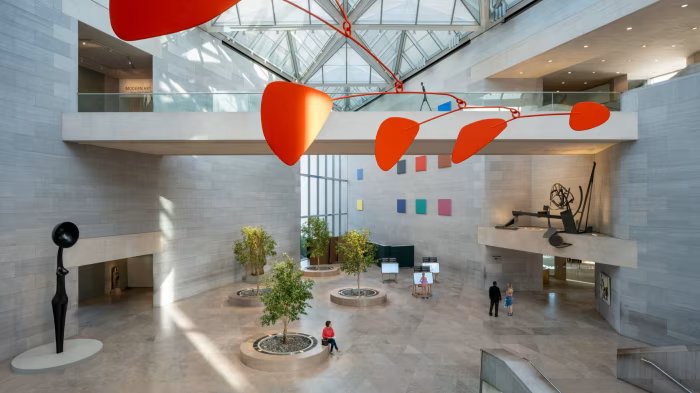
In 1950, Hans Namuth photographed Jackson Pollock leaping, twisting, bending and tossing paint at a canvas he had stretched out on his studio floor on Long Island. According to legend, Pollock celebrated the completion of “Lavender Mist” with his first shot of whiskey in two years. The photos cemented Pollock’s fame at the very moment he began his downward slide. This masterpiece dates from that shortlived creative apex. Even in the pristine environment of the National Gallery’s East Building, the painting radiates the man’s messy personality and intense physical presence: two sets of spectral handprints stain the upper corners. “I don’t paint nature, I am nature,” Pollock insisted, and six years later he got his wish, crashing his car when he hurtled headfirst into a tree. East Building, Upper Level, Gallery 407-B. Website; Directions
-
While you’re here: Look at it from the bus stop on Fourth Street. IM Pei’s East Building can be a troublesome place to show art, but its sharp angles and marble facets make it a great civic sculpture.
The Smithsonian American Art Museum to see its four colour paintings (1970-1976) by Alma Thomas


If it’s a gloomy winter day on the Mall — or I’m in a wintry mood — a stop in front of the euphoric, intensely polychromatic and cosmic canvases of Alma Thomas rarely fails to buoy my spirits. “Through colour,” she wrote, “I have sought to concentrate on beauty and happiness, rather than on man’s inhumanity to man.” Thomas’s story defies defeatism (a common ailment in the US capital). She fled the Jim Crow South for Washington DC in 1907, taught at middle-school level for 35 years and, despite suffering from arthritis and failing eyesight, went on to conduct a second career as a painter. Somehow, the more constrained she was by her body, the freer her painting became; the later, looser work is a lesson in purposeful joy. In 1972, she became the first Black woman to have a solo show at the Whitney, but even now the Smithsonian has only four of her works on view, scattered across several floors. Many more remain stashed in the vaults, waiting their turn to emerge into the artificial light. 1st Floor, 3rd Floor and Luce Foundation Centre. Website; Directions
-
While you’re here: Edward Hopper’s “Cape Cod Morning” (1950) is as tense and melancholy as Thomas’s paintings are exuberant — I know that feeling of looking out the window, hoping that’s not a calamity I see approaching. First Floor, South Wing
The Hirshhorn Museum to see . . . the Hirshhorn Museum


This great concrete bagel of a museum appears to levitate, as if to show its neighbours on the Mall what a heavy building can achieve. In this case, I’m choosing the building itself. Gordon Bunshaft designed the brutalist behemoth to house the collection of Joseph Hirshhorn, the mining tycoon and insatiable art consumer — it is a confluence of plutocratic largesse, architectural style and available land that’s inconceivable today. Hirshhorn donated 6,000 modern paintings and sculptures to the federal government in 1966; at his death 15 years later, he doubled that trove. The museum hosts a quirky mix of temporary exhibitions (currently a solo exhibition for painter Adam Pendleton, and one that puts Basquiat’s work next to Banksy’s) alongside its permanent collection. Website; Directions
-
While you’re here: The sculpture garden is embedded in the museum’s identity, but it has been closed for renovations, so I’m looking forward to the new version, reconceived by the Japanese photographer and architect Hiroshi Sugimoto, which is due to open next year.
The Kreeger Museum to see Piet Mondrian’s ‘Dying Sunflower’ (1908)

Piet Mondrian, that oh-so-imitable purveyor of toy-coloured grids, also had a fondness for decay. His wilted bloom is startling in its vividness — you can practically inhale the floral stink — and in its expressively drooping glory. The Kreeger is a good place to ponder it. Aloof from the political vexations and tourist bustle of downtown, surrounded by the quasi-suburban greenery of Northwest Washington, it’s an oasis of calm — but also a haven for turbulent imaginations. A cornucopia of works by Munch, Monet, Beckmann and Braque keeps things both lively and fierce. Salon. Website; Directions
The National Museum of African American Heritage and Culture to see Marian Anderson’s concert dress (mid-20th century)

A gown is like a ghost, a not-quite-living embodiment of a vanished spirit. At least that’s what I see when I look at the exquisitely simple swath of bronze-coloured satin that the great contralto Marian Anderson wore as a form of ceremonial armour. Whenever she appeared onstage, she carried the weight of history and the nation’s obsessions with race on her exposed shoulders. But the dress also makes me think of one time she didn’t wear it: in her outrageously belated debut at the Metropolitan Opera, when she donned the costume of the fortune teller Ulrica in Verdi’s Un Ballo in Maschera and became the company’s first Black singer in a major role. Musical Crossroads Gallery. Website; Directions
-
While you’re here: Take a close look at the bronzed grillwork panels that screen the museum from the sun. The abstract patterns are derived from the carvings on a Yoruba column, and they give the museum its dark but vibrant presence among the Mall’s collection of pale and stony buildings.
You can explore more of our DC guide here, including Ed Luce on where Maga power dines. You may also like our My Top Ten series, where our critics share their favourite artworks in cities across the world.
Follow FT Globetrotter on Instagram at @FTGlobetrotter
Cities with the FT

FT Globetrotter, our insider guides to some of the world’s greatest cities, offers expert advice on eating and drinking, exercise, art and culture — and much more
Find us in Washington DC, Miami, London, Paris, Rome, Tokyo, New York, Los Angeles, Lagos, Frankfurt, Singapore, Hong Kong, Toronto, Madrid, Melbourne, Copenhagen, Zürich, Istanbul, Milan, Vancouver, Edinburgh and Venice