

ArtReview walks you through some of the works included in Foreigners Everywhere from the National Gallery Singapore collection

‘Broadly speaking, “Art” in the West has become inflated at the expense of life. Aesthetics have triumphed over vitality. These paintings redress the balance. They are the result of participation rather than contemplation, action rather than introspection.’ That’s the one of the twentieth century’s greatest (Western) art critics, John Berger, author of Ways of Seeing (1972), writing in 1952 about the work of self-taught Indonesian painter Affandi. Affandi’s 1975 self-portrait, a swirl of coalescing colours is one of a number of works from the collection of National Gallery Singapore (the Gallery) that take centre stage in the main exhibition of this summer’s Venice Biennale, titled Foreigners Everywhere and curated by the director of the São Paulo Museum of Art (MASP), Adriano Pedrosa. It promises to be another redressing of the balance of sorts, and marks the Gallery’s first-ever participation in the Venice Biennale.
With more than 8000 artworks in its collection, National Gallery Singapore, which opened to the public in 2015, now holds one of the world’s preeminent collections of art from Southeast Asia, one of the world’s most diverse cultural and geographical regions, and home to an equally diverse range of geographically specific interpretations of modernism. And as such, the institution’s holdings present a variety of alternative art histories to the dominant narratives constructed in and projected by Europe. Most recently this could be seen in the Gallery’s blockbuster exhibition, Tropical (2023), which broadened the geography to explore the solidarities and differences between the anti-colonial impulses that drove the development of both society and modern and contemporary art in Southeast Asia and Latin America.
If Tropical was an expression of the Gallery’s mission to explore new connections and the transcultural relevance of art from Southeast Asia, then the inclusion of portraits by Lê Phổ, Georgette Chen, Emiria Sunassa, Chua Mia Tee, Lim Mu Hue, Lai Foong Moi, Hendra Gunawan and Affandi in Pedrosa’s ‘Nucleo Storico’ (historical nucleus) section of the main exhibition acts as both its coda and a next step in framing the art of Southeast Asia in a global context, standing not at the periphery of art history, but as a generator of art histories. Historical trajectories that are generated, in the case of the Gallery’s collection as a whole, by practitioners who represent artistic tendencies, social commentary and histories from countries as disparate as Brunei, Cambodia, Indonesia, Laos, Malaysia, Myanmar, the Philippines, Singapore, Thailand, and Vietnam. In a sense, you might say that one of the themes that the Gallery’s collection demonstrates is the extent to which the crosscultural is inherent in Southeast Asia in the first place.

Of the works presented in Venice, the Vietnamese painter Lê Phổ’s Jeune fille en blanc (Young Girl in White) (1931) presents a study of a particular individual: the background plain, her body composed of nothing but the white fabric of her ao dai, her hair tied back with her hair tied back demurely, leaving all the attention on the particularities of her face. While works of this type were frequently sold to French collectors or exhibited in colonial exhibitions, this painting is not defined by the colonial gaze. An extract of an eighteenth-century Vietnamese poem, about the distress of a soldier’s wife, appears in the upper corner of the work, explaining the woman’s expression of quiet thoughtfulness and resignation. She remains a subject rather than a colonial object. And it’s this sense of self-definition that flows through many of the other works selected for Pedrosa’s show.
Emiria Sunassa, one of Indonesia’s first female modern painters, also proclaimed herself ‘Queen of Papua’ by descent. The title was never officially recognised, but nevertheless inflects how we might interpret her portrait – Orang Irian dengan burung tjenderawasih (Irian Man with Bird of Paradise), 1949 – of a seemingly shirtless Irian (West Papuan) man gazing directly out at the viewer while clutching the titular and native bird, whose spectacular plumage highlights its masculinity.
While Labourer (Lunch Break) (1965) by Lai Foong Moi, offers an insight into the lives of the often-forgotten subaltern people whose work helped transform Singapore into the modern state it is today. And, as a result of the inclusion of a Samsui woman from Guangdong, (China) in the background into the role that migration played in the development of the city-state.
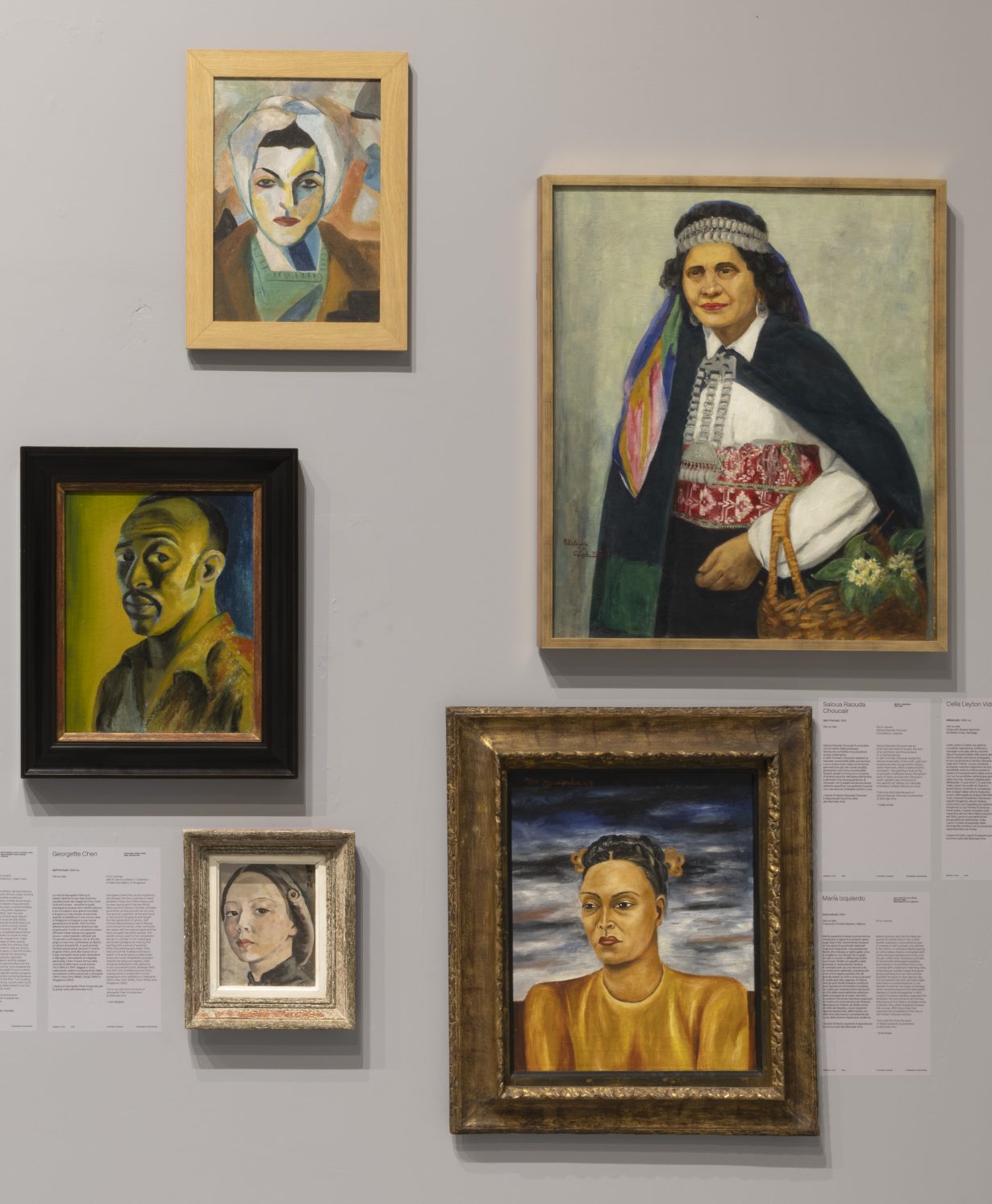
Perhaps these two types of narrative, the visual and the contemplative come together in Singaporean Georgette Chen’s Self Portrait (1946): it focuses on her head alone, her eyes staring out at the viewer, her hair curled according to the fashion of the time, the whole captured not long after her husband had passed away, following a period during which the couple were under house arrest in Shanghai.
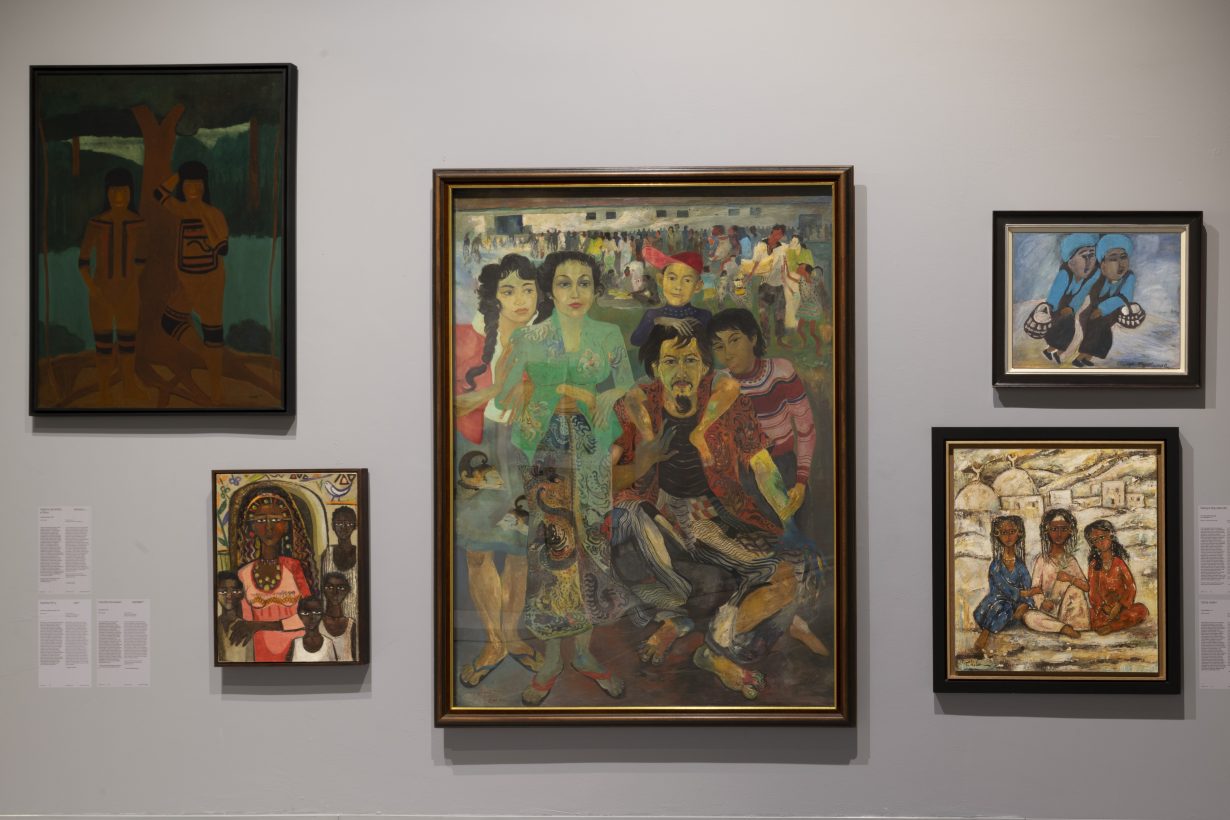
‘My subjects are expressive rather than beautiful,’ Affandi said of his own work. ‘I paint suffering – an old woman, a beggar, a black mountain … My great wish is that people learn a little from my work.’ And yet, as well as the truth, or voices, of those who didn’t have one, who were ignored, passed over or suppressed, the works on show from National Gallery Singapore’s collection also express the full spectrum of artistic styles that coalesce in Southeast Asian art – from Vietnamese modern painting with Lê Phổ to the expressionism of Indonesian Hendra Gunawan’s Family Portrait of 1968, to Singaporean Lim Mu Hue’s combination of both expressionist and realist tropes in Self-Expression (c.1957/1963), to harness a more analytic or conceptual approach to portraiture, in which the artist is captured, in his studio, wearing glasses that are snapped in two, the remaining eyepiece covering his right eye and reflecting the unseen scene in front of him or given that the viewer cannot verify that, perhaps something that’s in his head, to Affandi’s own adoption of paint squeezed directly out of tubes and manipulated by hand. Participation, action, and not a little introspection as well as vitality and aesthetics, and the different artistic paths to capturing them all.