

From her first encounters with stored rare paintings to the Kirby Art Study Center at the Williams Center, Okaya transformed how Lafayette cares for its extensive art collections
By Bryan Hay
Michiko Okaya, who started at Lafayette College in 1979 as gallery administrator, remembers art exhibitions in a renovated reading room at Van Wickle Hall and rare paintings stored in chicken wire crates with sharp edges, exposed to heat and humidity in attics and basements of academic buildings across campus.
“Plant Operations (now Facilities) had been responsible for the art collection, and it happily turned over the administration of the collection to me—I had worked at an art museum before moving to Easton,” she says.
Following American Museum Association guidelines and well aware of the visible need to abide by them, she set out to establish a first-class program, properly protecting and storing the College’s art collection, which encompasses more than 4,000 works.
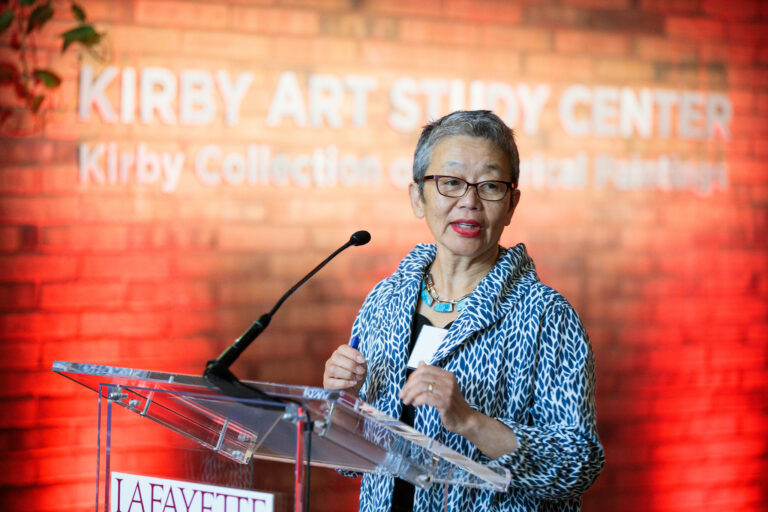
Michiko Okaya, curator emeritus
“The collection was scattered in many places,” says Okaya, who retired in 2020 as the College’s first director of art galleries and collections curator. “I had worked in an art museum before coming to Lafayette. So, I knew that the conditions where the artwork was being stored barely met any kind of conservation standards.”
It seemed that hope was on the way when plans for Williams Arts Center were revealed, but Okaya noticed immediately that no space had been designated for art storage in the design. Instead, she was given space at Kirby Hall of Civil Rights, where she stored the artwork first in the basement and then to the attic, away from dampness and water seepage. For decades, she would transport large, heavy works of art to various destinations on campus for exhibits.
“I think I complained enough that they moved art storage from the Pardee Hall attic down to the lower level of Kirby Hall, across from Special Collections and Archives,” she says, recalling how rainwater would cascade down the back stairs and seep under the door jamb into the corridor between art storage and archives.
But when Kirby underwent renovations, architects proposed moving the art to the attic, a secure controlled space with access via an elevator.
“It had furnishings, painting racks and shelving, climate control, security cameras. So that was better. We were happy to get out of the basement, but the problem was that the collection was not accessible,” Okaya says. “There wasn’t a place to bring students or researchers who wanted to look at the collection easily. There was no place to show anything.”
It was not until 2018 when she found a permanent home at Williams Center with the opening of the Kirby Art Study Center located in the former Black Box theater, vacated when the theater department moved to the downtown campus. She argued that the 2,400-square-foot room would be the perfect and logical location for an art storage/study facility.
“After all, the Black Box was next to the art history classroom, a short hop from the art gallery, and off the public lobby of the art center,” Okaya says.
The center provides a modern museum-standard environment for the care, display, and study of the College’s art inventory, which includes the Kirby Collection of Historical Paintings of 18th‐ and 19th-century American art, works created at the Experimental Printmaking Institute (EPI), a significant photography collection, Native American pottery and baskets that had also been stored in Pardee Hall, as well as contemporary artworks.
With the Kirby Art Study Center, Lafayette joined its academic museum peers in acknowledging the importance of the study of original works of art by students across all disciplines.
“It’s a wonderful facility, thanks to the support from the A.P. Kirby Jr. Foundation and F.M. Kirby Foundation, and the family’s concern for the proper care of the Kirby Collection. There’s a study room, and there’s a large glass wall that separates the study area from the collection storage area and painting racks right adjacent to the glass wall,” she says. “There’s always artwork hanging on the painting rack, so you can always see something.”
Bringing together visual and performing arts
Okaya and Ellis Finger, the first director of Williams Center, often worked collaboratively on pairing art and concerts, highlighting the College’s art collections and exhibits in tandem with the Performance Series or with the Roethke Arts and Humanities Festival overseen by Finger.
“I worked with Ellis from the very beginning,” she says.
Some exhibitions were directly related to dance, music, and theater performances. Examples include gallery installations In the Absence of Memory by Ping Chong; an exhibition about genomics in conjunction with a performance of Ferocious Beauty: Genome by Liz Lerman Dance Exchange; an adaption of Michael Pollan’s The Omnivore’s Dilemma; Brandon Ballengee’s From Scales to Feathers, which marked the 150th anniversary of the publication of Charles Darwin’s On the Origin of Species; and a performance by butoh performer Taketeru Kudo, in conjunction with Michael Pestel’s multimedia installation Requiem: Ectopistes migratorius, marking the 100th anniversary of the extinction of the passenger pigeon.
“I thought it was really important to have the gallery open when there were public events in the Williams Center,” she says. “The Williams Center Gallery has presented a really interesting range of exhibitions from one person, to 19th-century paintings and prints, to contemporary work; interdisciplinary exhibitions supported by faculty across campus; and exhibitions developed and curated by faculty colleagues.
“Most people might not come specifically to Williams Center to see an exhibition. But if they’re coming for a performance, they’re likely to view exhibitions beforehand and during intermission,” Okaya adds. “It provides opportunities for visitors to have encounters with art that they wouldn’t otherwise experience.”
Among her many remembrances of successful collaborations between the Williams Center Gallery and Performance Series, a 2001 performance by cellist Joan Jeanrenaud stands out, an event in a semester-long Roethke Festival’s “Performance Artist” series.
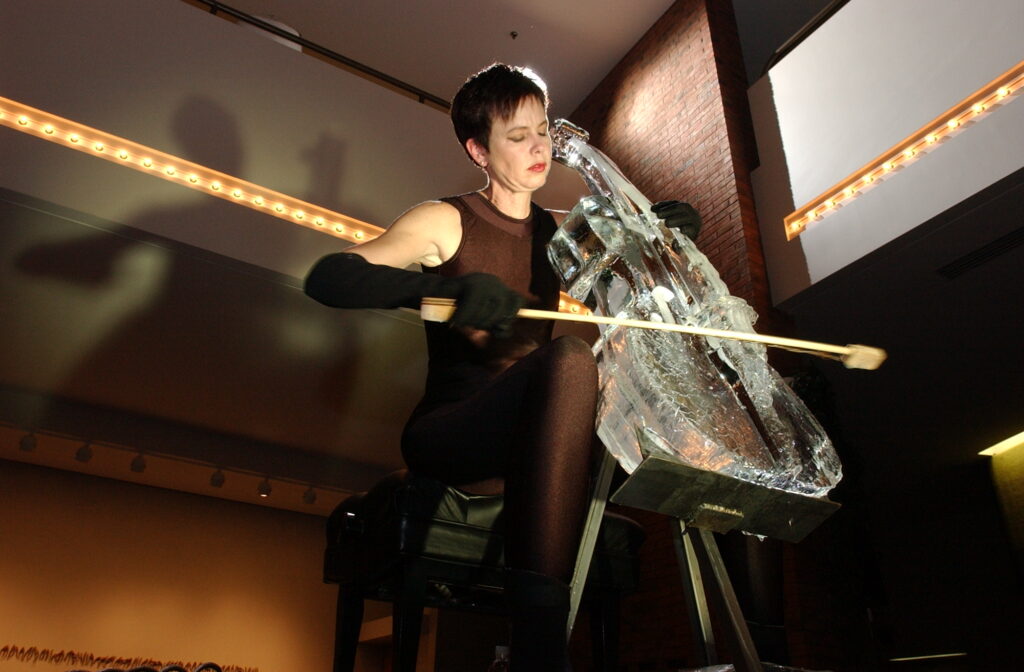
Joan Jeanrenaud presented “Ice Cello” in 2001.
Jeanrenaud presented “Ice Cello,” her creative restaging of avant-garde cellist Charlotte Mormon’s “Ice Music in London” (1972). A full-size “cello” made of ice was played with a variety of bows made of split bamboo, barbed wire, and rasps. Part of the innovative experience was awareness of the amplified sounds of dripping water from the slowly melting instrument. Composer and sound artist Gregory Kuhn manipulated the sounds and volume of the dripping water itself.
“Sometimes you thought it was like rain coming down in a lush forest,” Okaya recalls. “The cello looked so beautiful. The sound was amazing. She played it for about four hours, until the melting cello fell apart. People still tell me it was among the best events they ever saw. This is the magic of the Williams Center.”
Next up: Hollis Ashby, artistic and executive director of Williams Center for the Arts