
Close Menu
Finance Pro
  • Home
  • Art Gallery
  • Art Investment
  • Art Stocks
  • Cryptocurrency
  • Finance
  • Investing in Art
  • Investments
Facebook X (Twitter) Instagram
Trending
  • Best Degrees for a Hedge Fund Career: Finance, Math & More
  • Investment platforms and building societies clash over new Isa rules
  • What counts as art, and who gets to decide?
  • Hyderabad based UpTik to host international conference on investments and global affairs at BSE
  • Finance expert warns making this mistake could break the law
  • Is the US Dollar the World’s Most Successful Cryptocurrency?
  • Osborne Clarke and Legance advise Alpha Bank, Situs Asset Management Limited and Castello SGR S.p.A. in a €50 million financing to restructure a premium asset in Rome and purchase a property in Rozzano (Milan) – Osborne Clarke
  • How to Use Cryptocurrency for Everyday Shopping in 2026
  • Privacy Policy
  • Terms and Conditions
  • Get In Touch
Finance ProFinance Pro
  • Home
  • Art Gallery
  • Art Investment
  • Art Stocks
  • Cryptocurrency
  • Finance
  • Investing in Art
  • Investments
Finance Pro
Home»Art Gallery»The privately funded galleries breathing new life into London’s art world
Art Gallery

The privately funded galleries breathing new life into London’s art world

October 2, 20255 Mins Read


Despite the closures in recent years of several commercial galleries thanks to market woes and public institutions facing funding cuts, a growing number of privately funded, non-commercial galleries are breathing new life into London’s cultural landscape. This month sees the arrival of two new art spaces: Ibraaz and Yan Du Projects, both in Fitzrovia.

Ibraaz, funded by the Kamel Lazaar Foundation and run by Kamel Lazaar’s daughter Lina, occupies a grand, stone-fronted building that has been home to a hospital, a synagogue and a 19th-century clubhouse for German artists. Now, its six floors host a dedicated performance space, library, bookshop, café and, in the building’s cavernous hall, an exhibition space. Its programme is explicitly dedicated to highlighting what Lina Lazaar describes as “global majority” artists — those of African, Asian, indigenous, Latin American or mixed-heritage backgrounds.

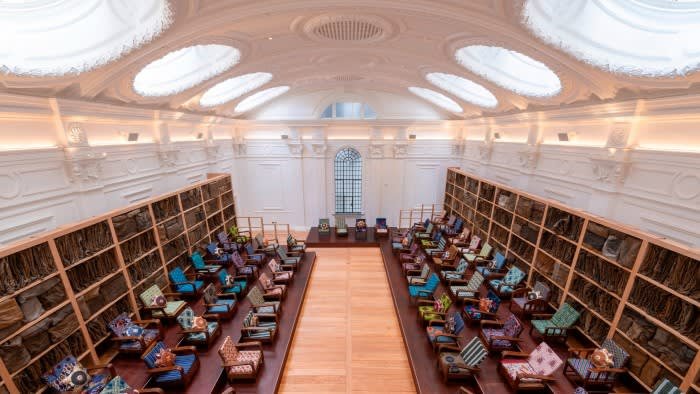
Installation view of Ibrahim Mahama’s ‘Parliament of Ghosts’ showing rows of colourful, patterned chairs and large shelves with folded materials in a grand, sky-lit hall
Installation view of Ibrahim Mahama’s work ‘Parliament of Ghosts’, showing at Ibraaz from this month © Hugo Glendinning, courtesy of Ibraaz and Ibrahim Mahama

For its first exhibition, Ghanaian artist Ibrahim Mahama’s evolving interactive installation Parliament of Ghosts has turned the room into a political chamber replete with repurposed Ghanaian textiles. The space has been transformed, down to the floorboards, which are made of wood from Ghana’s railway stations. It’s an ambitious exhibition, and one that was no doubt costly to stage. Lazaar tells me that Ibraaz has signed a 15-year lease and is completely self-funded. “We’re extremely blessed in that sense,” she adds.

Around the corner in an 18th-century townhouse on Bedford Square, Yan Du Projects, funded and overseen by the eponymous art collector, comprises multiple floors for exhibitions as well as a studio for artists in residence. “We are very focused on supporting the artists who are overlooked by the art market, especially in an international context,” Du tells me, adding that the gallery will focus on the Asian diaspora. Its first exhibition will comprise three floors of paintings and sculptures by Duan Jianyu — a major painter in China who rarely shows outside of her home country.

The white stone fronted exterior of a Georgian townhouse in London
Yan Du Projects occupies a Grade I-listed Georgian townhouse in Bedford Square, Fitzrovia
Portrait of Yan Du, wearing a long pale-blue shirt and wide-legged khaki trousers, standing by the tall, floor-to-ceiling window of a Georgian townhouse.
Yan Du, the Chinese-born, London-based art collector and philanthropist behind YDP © Jooney Woodward, courtesy of YDP

Du wants the space to feel personal: “It’s homemaking for the artists, for the curators,” she tells me. “We are private, but we are welcoming.”

Privately funded art spaces in London have various purposes. The Brown Collection in Marylebone, opened in 2022 by Glenn Brown, is a more traditional private museum — one that displays his work (known for its appropriation of historical paintings) alongside old masters from the artist’s own collection. It’s a model that draws “visual connections between things”, Brown says. “Mark-making is very important.”

A gallery room with blue walls displays various portraits, including a large central painting of a figure with blue skin and red hair. A black leather chair and a wooden cabinet with books are in the foreground.
Installation shot of ‘Hoi Polloi’, a show at the Brown Collection, featuring work by Glenn Brown © The Brown Collection

In contrast, Du’s private collection of more than 500 works, including by Yayoi Kusama, Georgia O’Keeffe and Louise Bourgeois, won’t appear in her new space, whose goal she says is to instead “advocate for communities and ecosystems”.

Alexander Petalas, who founded The Perimeter in 2018, started with weekly, appointment-only tours of his collection of contemporary art, which includes work by Wolfgang Tillmans and Sarah Lucas. Now, he hosts a year-round exhibition programme anchored by artists in the collection, and plans to expand his Bloomsbury space. “It’s grown into something that feels a bit unstoppable,” he says.

Several sculptures by Sarah Lucas are displayed in a brightly lit gallery with peach-colored walls, including a cast of human legs and torso, a yellow resin piece, and a jacket draped over a chair.
Installation view of Sarah Lucas’s 2021 show ‘Sex Life’ at The Perimeter, a gallery in Bloomsbury © Robert Glowacki, courtesy the artist and Sadie Coles

As Georgina Adam, author of The Rise and Rise of the Private Art Museum, explains, “a lot of [these spaces] shy away from the word ‘museum’.” But their activities — programming free-to-visit exhibitions with no sales mandate — make them a natural comparison.

A key difference is that their funding decisions are in the hands of their owners whereas, in the public sector, institutions are regularly forced to adapt in order to avoid unpredictable shortfalls. Tate, for example, has continued shedding staff since the pandemic, having reported a deficit budget for 2024-25 thanks to a reduction in paying visitors from abroad.

View of a white-walled gallery, with a framed photograph by Christopher Williams showing two wheat stalks against a vivid blue background hangs on a white gallery wall.
View inside The Perimeter, with ‘Harvest Season’ (2017) by Christopher Williams visible next to a doorway © 2025 Christopher Williams Photography by Stephen James

“There aren’t as many restrictions and logistical and administrative hoops we need to jump through in order to stage exhibitions that we think are interesting,” Petalas says. Though they tend to have advisory boards, decisions about what happens in these places often come down to the person funding them. “I trust myself,” says Du, “I know what I’m doing.”

Wigmore Hall, the classical music venue in London, recently decided to stop accepting public funding. Its director John Gilhooly cited the administrative requirements of Arts Council England’s Let’s Create strategy, which aims to broaden access to the arts, as a key reason, telling the BBC that “the current policy is just too onerous”. 

An illustration showing a person in red holding an animal, with birds flying nearby and a figure carrying sticks walking on a path through green hills.
‘Yúqiáo’ (The Fisherman and The Woodcutter) No.2 (2023) by Duan Jianyu, on show at YDP © Courtesy the artist and Vitamin Creative Space

And in America, worries about government steering public arts institutions are growing as Donald Trump escalates his campaign to purge the Smithsonian of “divisive or ideologically driven language”, ordering a review of its programming and operations such that it reflects “the unity, progress, and enduring values that define the American story”.

Cultural funding is conditional, and most of it is fragile. In avoiding the public sector’s compromises and the assumptions that governments aren’t themselves subject to ideological over-reach, privately run spaces can better embody their owners’ singular visions. At Ibraaz, Lazaar tells me, “the resources really serve the vision, and not the other way around”.

From October 14, ydp.co
From October 15,
ibraaz.org

Find out about our latest stories first — follow FT Weekend on Instagram, Bluesky and X, and sign up to receive the FT Weekend newsletter every Saturday morning


Source link

Share. Facebook Twitter Pinterest LinkedIn Tumblr Email

Related Posts

What counts as art, and who gets to decide?

January 23, 2026 Art Gallery

Devin Gawarvala founder of Bespoke Art Gallery, Ahmedabad presents Haiku of a Still Mind: Continuum · Consciousness · Coherence, a solo exhibition by Satish Gupta. The exhibition unfolds as a quiet and reflective space where stillness becomes an active – Bold Outline

January 21, 2026 Art Gallery

An Art Lover’s Guide to the Best Galleries and Museums in Morocco

January 20, 2026 Art Gallery

Comment | Reflecting on my father’s art and life on the occasion of his posthumous exhibition – The Art Newspaper

January 20, 2026 Art Gallery

Video: New Look At The Ocean Virtual Gallery

January 19, 2026 Art Gallery

Artist Crosses Catalina Channel In Mushroom Kayak, Inspires New Exhibition Los Angeles artist Sam Shoemaker successfully crossed the Catalina Channel in August aboard a kayak constructed entirely from mushroom mycelium. The extraordinary 26-nautic – facebook.com

January 16, 2026 Art Gallery
Add A Comment
Leave A Reply Cancel Reply

Don't Miss

Best Degrees for a Hedge Fund Career: Finance, Math & More

January 23, 2026 Finance 5 Mins Read

Key Takeaways Finance degrees prepare you for various hedge fund roles, including asset manager and…

Investment platforms and building societies clash over new Isa rules

January 23, 2026

What counts as art, and who gets to decide?

January 23, 2026

Hyderabad based UpTik to host international conference on investments and global affairs at BSE

January 23, 2026
Our Picks

Best Degrees for a Hedge Fund Career: Finance, Math & More

January 23, 2026

Investment platforms and building societies clash over new Isa rules

January 23, 2026

What counts as art, and who gets to decide?

January 23, 2026

Hyderabad based UpTik to host international conference on investments and global affairs at BSE

January 23, 2026
Our Picks

Temporary finance director joins Shropshire Council amid cash woes

January 22, 2026

Devin Gawarvala founder of Bespoke Art Gallery, Ahmedabad presents Haiku of a Still Mind: Continuum · Consciousness · Coherence, a solo exhibition by Satish Gupta. The exhibition unfolds as a quiet and reflective space where stillness becomes an active – Bold Outline

January 21, 2026

Vietnam Begins Accepting Applications for Cryptocurrency Trading Licenses

January 21, 2026
Latest updates

Best Degrees for a Hedge Fund Career: Finance, Math & More

January 23, 2026

Investment platforms and building societies clash over new Isa rules

January 23, 2026

What counts as art, and who gets to decide?

January 23, 2026
Weekly Updates

Masterworks.com Partners with Datalign Advisory to Enhance Art Investment Services

October 1, 2024

Investing in the Art and Collectables Market: A $1.7 Trillion Asset Class

August 5, 2021

Europe Faces A Dip In Foreign Investment Amid Challenges

May 2, 2024
  • Privacy Policy
  • Terms and Conditions
  • Get In Touch
© 2026 Finance Pro

Type above and press Enter to search. Press Esc to cancel.