
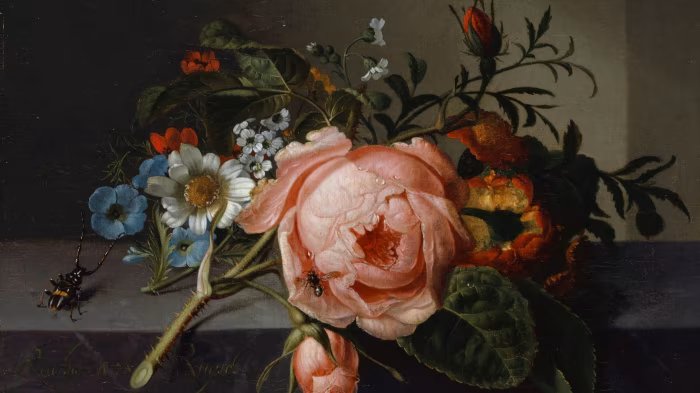
As gardens go to sleep in the week before Christmas, I find sustenance in the current flowering of botanical art. Art enhances what we see in plants and gardens and what we work for in our mind’s eye. Like gardening, it spans countries, peoples and generations. Like gardening, it is a skill at which individuals excel irrespective of social class, gender or whereabouts.
There are some fine lines here, difficult to draw decisively. Botanical art is not a category with rooms to itself in big city art galleries. There are several reasons for this lack. Some are practical. Much of this art is painted in watercolours, which fade with prolonged exhibition in direct light. Some of the best is painted on vellum, which will shrink or twist in changing temperatures and illumination.
Another reason is based in prejudice. Botanical art depends on drawing. Critics mis-class it as “copying” and consider it a skill for amateurs who work in part-time classes, not studios. Like that other thriving genre, portrait painting, botanical art is not considered by critics when they pronounce on the health, or not, of contemporary art. As botanical art is representational, it is not considered “modern”.

In his beautifully presented history, The Golden Age of Botanical Art, the expert Martyn Rix identifies a first golden age of the genre between 1750 and 1850 and duly presents Pierre-Joseph Redouté, active then, as one of the greatest flower painters of all time. Redouté certainly had illustrative intentions, related to botanical accuracy, when he painted the flowers of lilac, or the many new roses that were growing in the Empress Joséphine’s garden at Malmaison. Nonetheless he is a full-on botanical artist who has affected for ever the way I look on these flowers in my flower beds.
Florilegiums, or collections of flowers from a defined region, also straddle the categories. Physic and botanical gardens often attract groups of artists to paint specimens of dried flowers collected abroad. This year the superb Transylvania Florilegium, published by Addison Publications with support from King Charles, exemplifies in two volumes the fluid lines between utility and art. Its underlying watercolours, 124 in all, are intended as an accurate record of highlights of the rich flora of this part of Romania, but they are also the work of major botanical artists, selected to paint in nature with live plants around them. The brilliant Turkish botanical painter Işik Güner was one of those chosen, among others who were brought in from Japan, New Zealand and elsewhere. The book has a documentary dimension but its contents and binding mark it out as a work of art.


At a recent lecture in Oxford’s Ashmolean Museum, the doyenne of contemporary botanical art, Shirley Sherwood, spoke from the heart about her early training in botanical science and her collecting and patronage of botanical art, a Cinderella category, she had felt, when she began to engage with it in 1990. Since then she has enabled a purpose-built gallery named after her for exhibitions of botanical art at Kew Gardens, further animating the field.
She considers that botanical art differs from botanical illustration by being not just scientifically accurate, clear and detailed, but also by being inspired by past masters. One of them is the late Rory McEwen, whom I last reviewed here in November 2024, and who is currently the subject of a small but memorable show at the Garden Museum in London. McEwen classified himself as a botanical artist, saying that he aimed to catch the essence of a leaf, fruit or flower in his detailed brushwork on vellum. Sherwood endorses his claims, considering him a seminal artist for many others since. His paintings of dead leaves, done in the last years of his life, change what we see in them, transforming the chore of sweeping them up this weekend.


What about flower paintings, I asked Sherwood, a genre which great national galleries indeed include, whether by Da Vinci or Dürer, the Dutch masters, Delacroix, Van Gogh and even Manet, whose paintings of flowers in vases, done in his final months, remain the masterpieces to which my mind’s eye returns. This year the Museum of Fine Arts in Boston held a superb show, the first solo one ever, of the paintings of flowers and fruits by a genius, Rachel Ruysch (1664-1750), whose small output was done in Antwerp before her death aged 86. The excellent catalogue is subtitled “Nature into Art” and relates her most interestingly to networks of scientific knowledge. Her paintings combined flowers from many seasons into one vase, but her eye and detail surely qualify her as a botanical artist. She mostly painted living specimens, requiring her to spread each work over many months.
Botanical art, then, has a long and distinguished ancestry. Botanical journals, prizes and gardens have given it continuing impetus, and as Sherwood explained, it is thriving more than ever. She funds a yearly award for young botanical artists and in 2023-24 attracted a torrent of good entries, about 1,000 in all from 77 countries, all by artists aged between 16 and 25; that year’s prize went to Khánh Ly Nguyen from Vietnam.

Climate change and increased concern for ecology and biodiversity are propelling this engagement by young artists. Its branches beyond European art have long roots too. Chinese and Japanese artists are obvious examples. In India, Mughal rulers patronised the finest flower painters, truly botanical artists, as work in the margins of their miniatures show. Members of the East India Company in the 18th century used Indian artists for many of the paintings which represented the rich local flora, recorded it in botanical gardens and helped its future recognition.
Sherwood chose to form a private contemporary collection because Kew and other institutions already had such historic works in their care. It was the right choice at the right moment. Ferns, tropical fruits and orchids have long been artists’ subjects but she picked out in her lecture young artists such as Gustavo Surlo in Brazil or Waiwai Hove in Singapore, already up there with the best. Mieko Ishikawa, in Japan, is justly famous for her paintings of delicate cherry blossom but she has also been painting specimens from the rainforests of Borneo and acorns from Brunei. “Weird and wonderful” is this artist’s apt caption for such subjects.
Continuing exploration confronts artists with new subjects: a recent fashion for enlarging the scale of leaves or ferns increases their work’s impact. The floras of South Africa, South America, Thailand or Turkey inspire work that certainly belongs in art. I have not even mentioned mushrooms, including those hidden in Russian forests and sought out by keen artists there. I draw a heartening seasonal conclusion. While your flower beds cope with Britain’s warm wet winters, artists of all ages and origins are at work expressing the diversity of living plants and turning them into art through love.
Find out about our latest stories first — follow @ft_houseandhome on Instagram