
‘Often the most appropriate frame is the most invisible frame,’ says Peter Schade, head of framing at the National Gallery in London. The sentiment points to a paradox: the more Schade excels at his work, the less people will notice it. It’s only when tastes run counter to his own that we are reminded that how paintings are framed is always a choice, not an inevitability.
To get to our interview, I’m escorted through a discreet door in a gallery café into corridors rather like a hospital’s and then into a windowless workshop. Here, with the rumble of tube trains passing underneath, Schade creates, repairs and fits the frames that will protect masterpieces while also colouring our perceptions, whether we notice their effect or not.
The work may be quiet, but that doesn’t mean it doesn’t attract attention. Schade regularly posts his efforts on social media and the reframing of one of the gallery’s most famous paintings created more online discussion than usual. The before and after snaps of Van Eyck’s The Arnolfini Portrait (1434) show its new, unornamented 15th-century frame and the 19th century neo-Gothic frame of dark wood it replaced. One response on X (formerly Twitter) claimed that ‘Basically, the new frame forces our ideas of minimalism on the painting, even though it is an [sic] 15th century gilded moulding.’

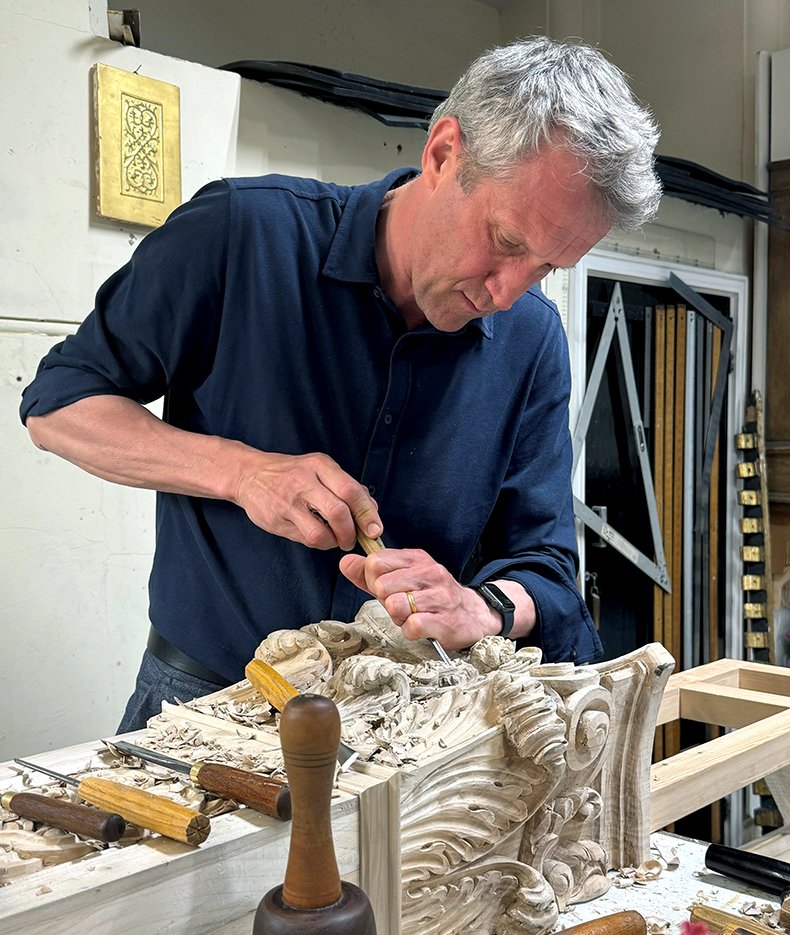
Peter Schade, the head of framing at the National Gallery, carving a frame from poplar wood. Photo: Joshua Page
What Schade is up against here is the friction between familiar ideas of the past versus historic evidence. The Victorian frame was ‘completely incongruous – like a fantasy Swiss chalet around the painting’. The contemporaneous frame was chosen in part due to its similarity to the frame housing Van Eyck’s Portrait of a Man (Self Portrait?) (1433), also in the collection, and to the way it brings that cool Northern European light alive. ‘The painted details are so sharp and fine, but then you had this odd, not very skilful carving competing for your attention.’
‘There’s a lot of… semi-knowledge about this subject,’ Schade says in a mild tone. ‘We didn’t reframe The Arnolfini Portrait in any way flippantly. Before, you couldn’t see the painting without also seeing the frame – whereas I think now the frame allows you to see the painting first.’ Schade is effusive about Van Eyck’s frames: ‘He quite often painted the frame himself – there’s a lot of marbled or stone-style frames, and frames with inscriptions. He plays all kinds of intriguing games with visual effects.’ (The website closertovaneyck.kikirpa.be is, he tells me, ‘a great place to zoom in on the splashes’.)

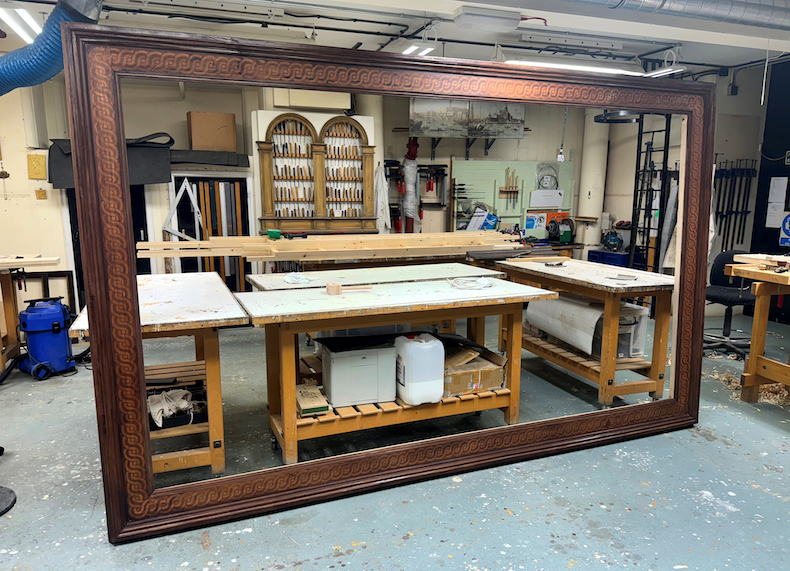
Work in progress at the framing studio. Photo: The National Gallery, London
Thanks to the closure of the museum’s Sainsbury Wing due to building work – its reopening is too late for the gallery’s 200th anniversary this month – Schade and his small team currently have access to works that are otherwise seldom off view. When I visit, the workshop floor is filled by a half-finished frame almost three metres long, designed to replace the 1950s reproduction antique that previously encased The Martyrdom of Saint Sebastian (1475) by Antonio and Piero del Pollaiuolo. However impressive the intricate carving of this half-finished piece, I can’t help but notice the tool rack beside it. It is a thing of beauty: a gilt diptych frame filled with neat rows of chisels. Schade uses the same materials and techniques used by framers of yore, rabbit-skin glue and all. The only exception: modern nails, which are apparently ‘much better’.
At 16, Schade – who is German – completed an apprenticeship as a woodcarver, before working at an antiques restoration company in Berlin. He moved to London in the early 1990s and found work with the framers Arnold Wiggins & Sons; after three years, he set up his own framing workshop. In 2005, the National Gallery invited him to apply for the role of head of framing. He still works for himself two days a week, both for the additional income and to avoid ‘becoming institutionalised. I think it’s kept me going – it gives me a bigger scope.’

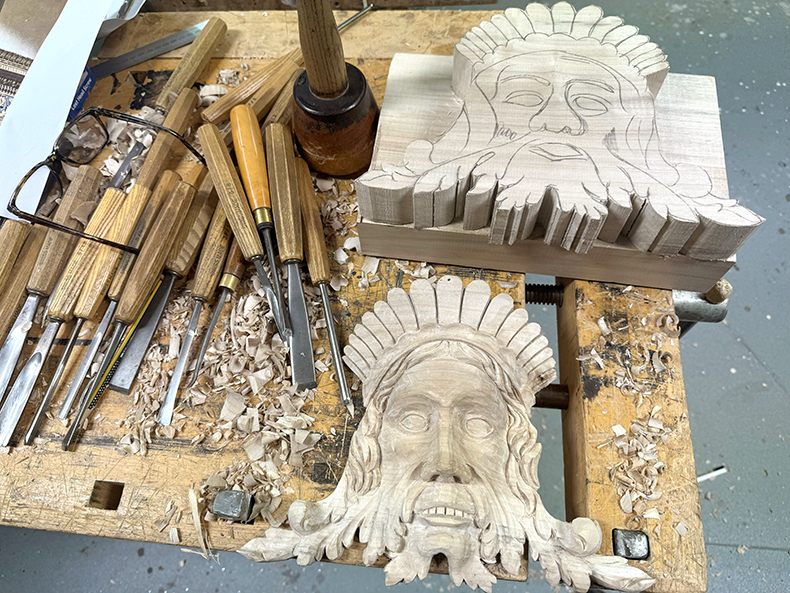
Work in progress at the framing workshop in the National Gallery. Photo: The National Gallery, London
In his 19 years at the NG, Schade has reframed almost 400 paintings: an average of around 20 a year. More than 250 have been placed in newly acquired antique frames, thanks to two or three ‘very loyal’ supporters who donate for the purpose every year. ‘There wasn’t any budget for that kind of thing when I first arrived, but now we have external funding it has been much, much easier,’ he says. He buys frames opportunistically: ‘When something comes up at an auction or a smaller dealer, I can react quickly rather than have some long process of finding funding. And that’s why we’ve been able to do so much with a relatively modest amount of money.’
For Schade, finding frames of the highest quality often comes first. Once a frame has been acquired, he then considers which painting it would best suit, before presenting his proposal to the relevant curator. Other times, the process begins when conservation treatment offers an opportunity to reassess a frame – as with Uccello’s The Battle of San Romano (c. 1438–40), for which Schade is making a new frame of inlaid walnut that better reflects historic evidence of how it was first displayed. ‘Originally these Uccello paintings were not framed – just set into niches. This new frame looks kind of like wall panelling from a Renaissance room.’
We changed the frame on Picasso’s 1914 Still Life yesterday. We replaced the 1970s dealer frame with an austere 17th century black plate frame; it looks much more modern and daring, draws out the subtle shades of grey and black and makes the composition more three dimensional. pic.twitter.com/Qe8561jLGp
— Peter Schade (@psframes) December 13, 2023
Which reframing has made the biggest difference, I ask? He demurs over a definitive answer but does point to Picasso’s Still Life (1914), which is now in an austere 17th-century black plate frame. Previously, it had a decorative Spanish-style black and gold frame that ‘completely fought with the composition,’ he says. ‘But in its new frame, the work suddenly looks three-dimensional, with the centre seeming to rise up. Suddenly it has a volume to it.’ Though this ‘new’ frame is three centuries older than the work, Still Life now appears far more modern than it did.
Another success – ‘possibly my favourite’, says Schade – was the reframing of Meindert Hobbema’s The Avenue at Middelharnis (1689). It was previously displayed in an 18th-century gilt frame punctuated by ornate decoration, originally designed for a portrait. ‘For landscapes, such frames don’t really work because there is no real emphasis in the composition at these points, which pulls up the horizon’s edges,’ he says, gesturing to the decorative elements. The painting is now in a narrow black frame that ‘lets the horizon stay down. The road seems to spill out into the room, whereas the previous frame made a kind of barrier.’

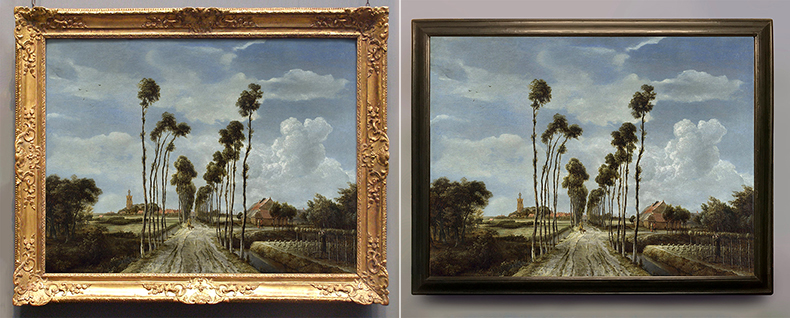
The Avenue at Middelharnis (1689) by Meindert Hobbema, before and after reframing. Photos: courtesy The National Gallery, London
This work is a delicate balance of art and craft: the skill to create a perfect imitation of a carved baroque cherub, for example, and the aesthetic sensitivity to anticipate what effect it will have on an artwork. There is scholarship, too, of course. The design for the new frame for the Pollaiuolos’ Saint Sebastian is drawn from Schade’s familiarity with original Pollaiuolo frames: pilasters from a work in San Gimignano, inner frame from one in the Uffizi, and predella and architrave from a Florentine frame of the period.
We should appreciate such skilled work while we can. Schade belongs to a generation that cut its teeth when London was the international centre for the trade in Old Master paintings. As collecting tastes change and supply dwindles, so has the market previously catered to by large framing workshops. Sole traders are often unable to take on apprentices or train inexperienced assistants. ‘It weighs on my mind that though my generation will probably be around for another 15–20 years, I can then see it all coming to an end. That’s a shame.’
There is a gravity to this quiet, unglamorous work that often passes unremarked. ‘Many of these frames will be on the paintings for a very long time. Some, when they’re particularly successful, could still be here in 200 years,’ Schade says. If we’re lucky, perhaps one of his successors could be interviewed in time for NG400 – or perhaps not.