
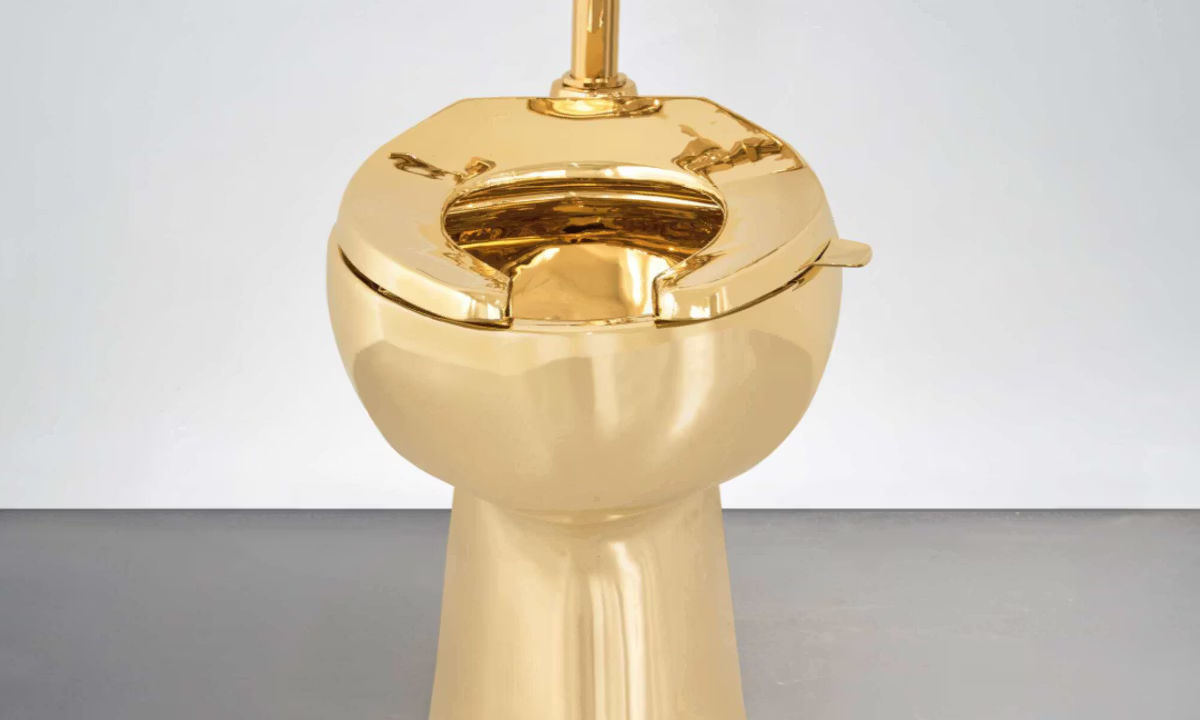
A week ago, at Sotheby’s in New York, Maurizio Cattelan’s solid gold toilet hammered for $10m, a smidge over its gold spot price of $9.8m. A case, then, of an artwork literally being worth its weight in gold. Or thereabouts.
It is probably one of the only examples of pricing in the history of the art market that makes quantifiable sense. Usually, art valuation is a far more nebulous concept. Take David Shrigley’s piles of old rope, which are currently on sale at Stephen Friedman Gallery for £1m. It’s an installation about how we value art beyond the cost of base materials, about how much some old rope is worth when you factor in other elements such as an artist’s reputation, historical context and a sense of humour.
At the time of writing, Shrigley’s installation had not yet found a home, but in the case of Cattelan’s toilet, the consignor, Steve Cohen, is likely to have made a healthy profit—as much as $5m according to calculations by Artnet. Sometimes you make money selling art, but often you don’t.
Dealers will always say collectors should only buy art they want to live with for a long time, but why then is so much it kept in freeports around the world? The Geneva Freeport alone is estimated to hold $100bn-worth of art. Geneva is considered the world’s largest storage facility, but there are around 3,500 freeports currently in operation around the world, meaning the scale of art kept locked behind reinforced doors could easily outweigh that which is on show in private museums and homes.
Declining returns
Nonetheless, recent research would suggest sea change is afoot. A new report from Deloitte and ArtTactic suggests that considering art as an asset class is no longer a good idea—hardly rocket science in a depressed art market. As the report notes: “After more than 14 years of tracking long-term performance, a clear trend has emerged: art returns are steadily declining. This makes the case for art as a strong standalone investment increasingly questionable, with Artnet indices showing consistent underperformance compared to other major asset classes.”
The cultural economist Clare McAndrew draws similar conclusions in the latest Art Basel and UBS Survey of Global Collecting, published last month. As she notes, several papers in recent years have delved into the return history of investment in art, looking at price indices as a way of examining the risks between investment in art and other financial assets. All consistently highlight that art investment is significantly riskier than real estate, commodities and government securities and on par or above that of large company stocks represented by the S&P 500.
Of course, that hasn’t stopped buyers and sellers over the past 25 years treating art as a financial asset. First there were art investment funds, among the most prominent the Fine Art Fund Group set up by Phillip Hoffman in 2004. Then came the fractionalisation of art works, allowing multiple stakeholders to own shares in a particular work. In recent years so-called investment galleries emerged, framing art as a safe haven for capital in times of economic uncertainty and claiming the returns on blue-chip works to have consistently outperformed the FTSE 100 share index. Some of these businesses are already beginning to fall away; Pictorum Advisory, for example, went into liquidation in September.
Wealth managers appear to be less willing to advise on art as an investment. According to the latest report by Deloitte, the average allocation to art and collectibles among family offices fell to 8.8% in 2025, down from 13.4% in 2023. Most allocations now fall between 3% and 10%, roughly the range private banks consider suitable for “passion assets”. Similarly, the Art Basel/UBS report shows that high-net-worth individuals are reducing their exposure to art, with average allocations falling to 15% in 2024, down from 19% in 2023 and 24% in 2022.
Whatever you eat, a $200 lunch or a $2 hot dog, the results are the same, toilet-wise
Maurizio Cattelan
At a conference organised by Deloitte in New York on 19 November, Betsy Bickar, the head of art advisory at Citi Wealth, said art should be approached as a cultural asset, not a financial one. “We don’t even use the word ‘investment’,” she told the audience. Regulatory and operational hurdles have given wealth managers and collectors pause for thought. Growing costs, from fees, transaction costs, insurance, storage, have also eaten into returns. The former hedge fund manager and collector Christian Levett notes how his storage costs have mushroomed by five times over the past six or seven years. “Talk in our office now centres on how we can get those costs down,” he tells The Art Newspaper.
Interest rates have also put a squeeze on the $40bn art lending sector; earlier this year top lenders including Sotheby’s and Christie’s issued margin calls, requesting borrowers for extra collateral or cash after the value of pledged works declined. Nonetheless, in the current climate, collectors may prefer to borrow against parts of their collections as a way of creating liquidity rather than selling their art at low prices. Either way, the landscape certainly feels more nuanced than in recent years.
Journalists and commentators are increasingly noting how art is being bought for the love of art, while art advisers and other professionals in the field say they are more concerned with art “holding its value” than pursuing financial returns. It’s a distinction Cattelan may not care for. He has said in the past that his gold toilet satirises super-wealth: “Whatever you eat, a $200 lunch or a $2 hot dog, the results are the same, toilet-wise.”
By contrast, the art market will by its very nature always be concerned with those differentials, even if the idea of art as an asset class has finally fallen out of fashion.