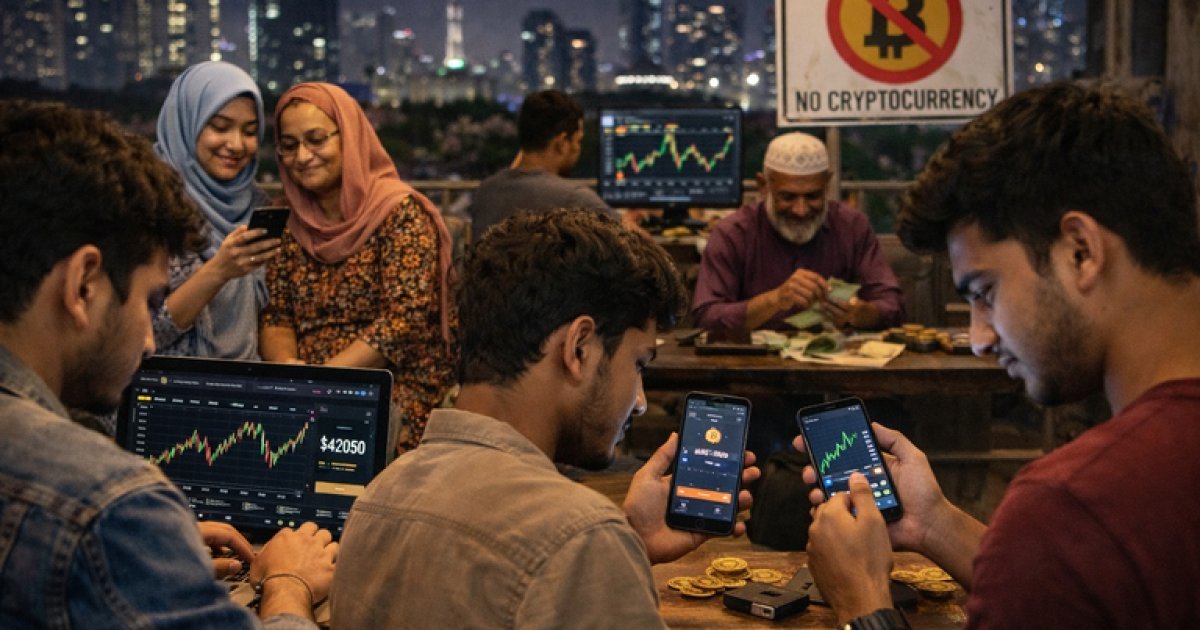
Cryptocurrency trading and transactions remain illegal in Bangladesh, yet hundreds of thousands of young people across the country are quietly earning, saving, and supporting their families through income generated from digital assets, according to users, experts, and global data.
Despite repeated warnings from Bangladesh Bank about money laundering and financial crimes, global blockchain analytics show Bangladesh has emerged as one of the world’s top crypto-adopting nations, driven largely by grassroots participation among young freelancers and online workers.
Bangladesh Bank opposed to crypto
Asked if the central bank is considering legalizing cryptocurrency, Arif Hossain Khan, executive director and spokesperson of Bangladesh Bank, said the regulator remains opposed for now.
“Bangladesh Bank is not thinking positively about cryptocurrency at this moment,” he told Dhaka Tribune. “This decision may change in the future, but for now, we are not taking it positively.”
On a central bank digital currency (CBDC), Khan said progress has been limited. “The initiative did not move forward significantly, though we may work on it in the future,” he added.
From tuition to crypto: A lifeline
Altaf Mahmud (pseudonym), a university student, turned to cryptocurrency after losing private tuition opportunities during the Covid-19 pandemic. Introduced by a friend to earning through airdrops and online events, he now earns between Tk60,000 and Tk70,000 a month.
With his crypto income, Altaf built a permanent house costing Tk13 lakh and spent nearly Tk3 lakh on medical treatment after both his parents suffered strokes within a week. “Now all my monthly expenses are covered through online income, including freelancing,” he said.
Crypto and freelancing
Saikat Ahmed (pseudonym), another public university student, questioned why crypto income is criminalized amid scarce formal employment.
“What we do is a form of freelancing,” he said. “The government cannot provide good jobs. After graduation, the salary from a job barely covers personal expenses. How do we support a family?”
He added that most young users avoid illegal activity and earn without capital. “Many people think crypto automatically means something dangerous. We need to move beyond that mindset. In many developed countries, crypto is legal and used like money.”
Ahmed noted that hundreds of thousands of youths earn hundreds of crores of taka, but remain silent because crypto is treated like a crime.
A hidden digital economy
Thousands of Telegram communities have emerged around crypto freelancing, where users share information on airdrops, events, and online tasks. An administrator of one group, speaking anonymously, said: “This is freelancing. We don’t do anything unethical. The government should bring crypto under a policy framework instead of keeping it illegal.”
Despite the ban, Bangladeshis remain active on global crypto exchanges such as Binance, often conducting peer-to-peer (P2P) trades through mobile financial services like bKash, Nagad, and Rocket. One user said regulating crypto could generate hundreds of crores of taka annually in tax revenue.
Bangladesh among top crypto-using nations
According to the 2025 Global Crypto Adoption Index by Chainalysis, Bangladesh ranks 13th out of 151 countries, up from 17th in 2024, trailing only India in South Asia. The index measures grassroots adoption rather than transaction value, and noted that crypto adoption grows fastest in developing countries with young populations, digital payments, and freelance economies.
Drivers of crypto growth
Crypto adoption continues despite the ban due to peer-to-peer trading, freelancing, overseas remittances, online gaming, digital services, and as a hedge against inflation. Freelancers often receive payments from foreign clients in stablecoins like USDT for faster, cheaper transfers. Chainalysis data from July 2024 to June 2025 shows grassroots crypto use has made Bangladesh a significant player in the global ecosystem.
Legal vacuum and enforcement
Bangladesh Bank has warned that crypto violates the Foreign Exchange Regulation Act, 1947, and the Money Laundering Prevention Act, 2012. Enforcement agencies treat crypto use as illegal under existing financial laws, though ownership is not explicitly criminalized. Authorities cite risks of money laundering, terror financing, and capital flight, noting illegal online betting platforms may use crypto to evade oversight.
Global context and regional debate
Globally, countries such as the US, Canada, the UK, Japan, and South Korea allow crypto under regulatory frameworks. The EU recognizes it as a digital asset. In South Asia, India and Pakistan do not recognize crypto as legal tender but do not ban ownership. India’s Madras High Court has recognized cryptocurrency as property.
Professor Mustafizur Rahman, distinguished fellow at the CPD, said Bangladesh must first assess its readiness for digital currencies. “The government must first develop a clear understanding of cryptocurrency,” he said, noting that without transparency and knowledge, creating a regulatory framework would be difficult.