
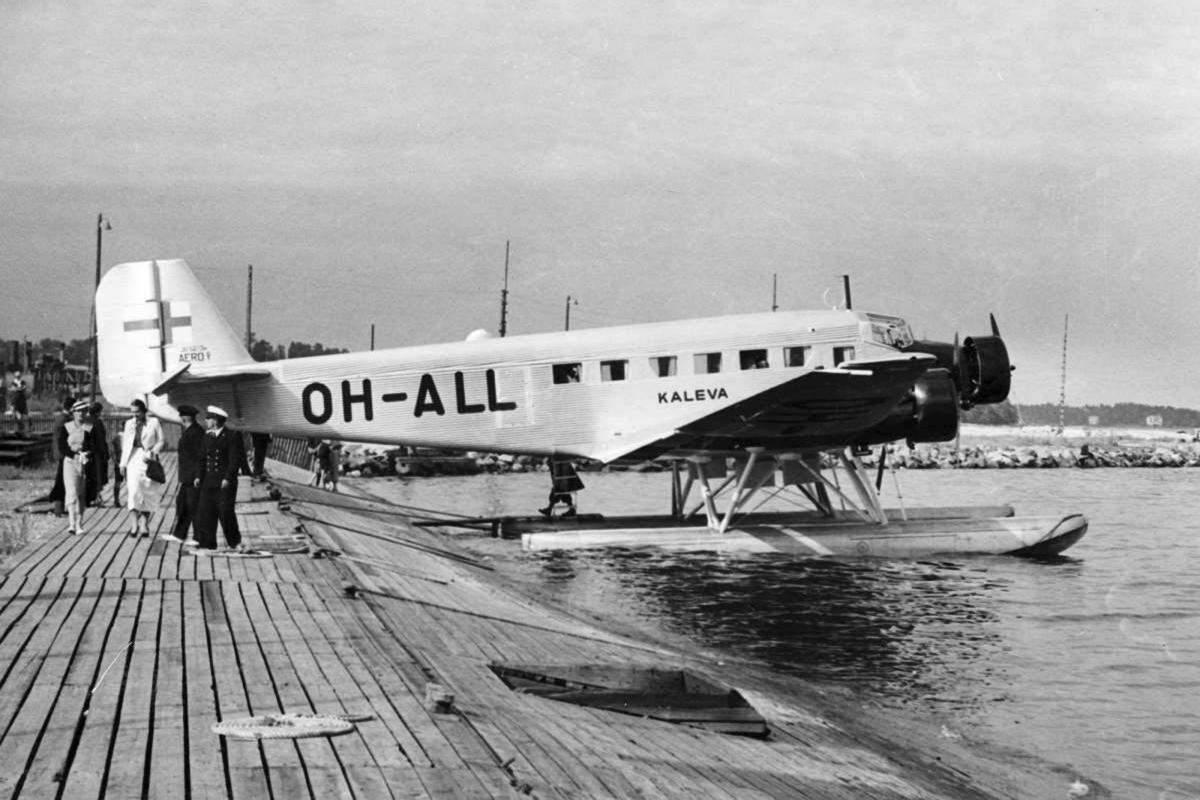
HELSINKI (AP) — The World War II mystery of what happened to a Finnish passenger plane after it was shot down over the Baltic Sea by Soviet bombers appears to finally be solved more than eight decades later.
The plane was carrying American and French diplomatic couriers in June 1940 when it was downed just days before Moscow annexed the Baltic states. All nine people on board the plane were killed, including the two-member Finnish crew and the seven passengers — an American diplomat, two French, two Germans, a Swede and a dual Estonian-Finnish national.
A diving and salvage team in Estonia said this week that it had located well-preserved parts and debris from the Junkers Ju 52 plane operated by Finnish airline Aero, which is now Finnair. It was found off the tiny island of Keri near Estonia’s capital, Tallinn, at a depth of around 70 meters (230 feet).
“Basically, we started from scratch. We took a whole different approach to the search,” Kaido Peremees, spokesman for the Estonian diving and underwater survey company Tuukritoode OU, explained the group’s success in finding the plane’s remains.
The downing of the civilian plane, named Kaleva, en route from Tallinn to Helsinki happened on June 14, 1940 — just three months after Finland had signed a peace treaty with Moscow following the 1939-40 Winter War.
The news about the fate of the plane was met with disbelief and anger by authorities in Helsinki who were informed that it was shot down by two Soviet DB-3 bombers 10 minutes after taking off from Tallinn’s Ulemiste airport.
“It was unique that a passenger plane was shot down during peacetime on a normal scheduled flight,” said Finnish aviation historian Carl-Fredrik Geust, who has investigated Kaleva’s case since the 1980s.
Finland officially kept silent for years about the details of the aircraft’s destruction, saying publicly only that a “mysterious crash” had taken place over the Baltic Sea, because it didn’t want to provoke Moscow.
Though well documented by books, research and television documentaries, the 84-year-old mystery has intrigued Finns. The case is an essential part of the Nordic country’s complex World War II history and sheds light into its troubled ties with Moscow.
But perhaps more importantly, the downing of the plane happened at a critical time just days before Josef Stalin’s Soviet Union was preparing to annex the three Baltic states, sealing the fate of Estonia, Latvia and Lithuania for the next half-century before they eventually regained independence in 1991.
Moscow occupied Estonia on June 17, 1940 and Kaleva’s doomed journey was the last flight out of Tallinn, though Soviets had already started enforcing a tight transport embargo around the Estonian capital.
American diplomat Henry W. Antheil Jr., who is now considered one of the first U.S. casualties of World War II, was aboard the plane when it went down.
The 27-year-old Antheil, the younger brother of the acclaimed composer and pianist George Antheil, was on a rushed government mission evacuating sensitive diplomatic pouches from U.S. missions in Tallinn and Riga, Latvia, as it had become clear that Moscow was preparing to swallow up the small Baltic nations.
An Associated Press wire item dated June 15, 1940 noted that “Henry W. Antheil Jr. of Trenton, N. J., attached to the United States Legation in Helsinki, was killed in the mysterious explosion of a Finnish airliner yesterday.” In the U.S. media, Antheil’s death was overshadowed by much bigger news from Europe at the time: the Nazi occupation of Paris.
The U.S. Embassy in Tallinn has thoroughly documented and researched the case over the years.
Embassy spokesman Mike Snyder told the AP that “news of the possible location of the wreck of the Kaleva passenger plane is of great interest to the United States, especially since one of the first U.S. casualties of the Second World War, Diplomat Henry Antheil, occurred as a result of the plane being downed.”
Earlier this month, the U.S. ambassador in Estonia, George P. Kent, shared a post on X that included photos of Antheil, Kaleva and a memorial plaque by the American Foreign Service Association in Washington with Antheil’s name engraved in it.
Kaleva was carrying 227 kilograms (500 pounds) of diplomatic post, including Antheil’s pouches and material from two French diplomatic couriers — identified as Paul Longuet and Frederic Marty.
Estonian fishermen and the lighthouse operator on Keri told Finnish media decades after the downing of the plane that a Soviet submarine surfaced close to Kaleva’s crash site and retrieved floating debris, including document pouches, that had been collected by fishermen from the site.
This has led to conspiracy theories regarding the contents of the pouches and Moscow’s decision to shoot down the plane. It still remains unclear why precisely the Soviet Union decided to down a civilian Finnish passenger plane during peacetime.
“Lots of speculation on the plane’s cargo has been heard over the years,” Geust said. “What was the plane transporting? Many suggest Moscow wanted to prevent sensitive material and documents from exiting Estonia.”
But he said that it could have simply been “a mistake” by the Soviet bomber pilots.
Various attempts to find Kaleva have been recorded since Estonia regained independence more than three decades ago. However, none of them have been successful.
Not even the U.S. Navy’s oceanographic survey vessel Pathfinder could locate remains of the plane in a 2008 search around the Keri island in a venture commissioned by the Estonian government from the Pentagon.
“The wreckage is in pieces and the seabed is quite challenging with rock formations, valleys and hills. It’s very easy to miss” small parts and debris from the aircraft, Peremees said. “Techniques have, of course, evolved a lot over the time. As always, you can have good technology but be out of luck.”
New video taken by underwater robots from Peremees’ company show clear images of the three-engine Junkers’ landing gear, one of the motors and parts of the wings.
Peremees and his group are “absolutely” convinced the parts belong to Kaleva because of the distinctive and recognizable design of the German-made Junkers Ju 52, one of the most popular European passenger and wartime transport planes in the 1930s and early 1940s.
The plane was operated by the predecessor of the Finnish national airline Finnair.
Jaakko Schildt, chief operations officer of Finnair, described Kaleva’s downing as “a tragic and profoundly sad event for the young airline” that Finnair, then named Aero, was in 1940.
“Finding the wreckage of Kaleva in a way brings closure to this, even though it does not bring back the lives of our customers and crew that were lost,” Schildt said. “The interest towards locating Kaleva in the Baltic Sea speaks of the importance this tragic event has in the aviation history of our region.”
Peremees said his company would now focus on creating 3D images of Kaleva’s debris and discuss with Estonian authorities about the possibility of raising some of the items and, if found, the plane’s cargo and human remains.
Snyder from the U.S. Embassy in Tallinn said that Washington is closely monitoring the diving group’s efforts.
“We are following the investigation of the site and will be happy to discuss with our Finnish and Estonian (NATO) allies any developments resulting from recovery efforts,” Snyder said.
A stone memorial set up in the early 1990s to the victims of the Kaleva crash is located on Keri, and Helsinki’s old preserved Malmi airport terminal building, where Kaleva was supposed to arrive, has a memorial plaque set up in 2020 with the names of the victims.