
The government must step in with fiscal support, such as funds and incentives, and ensure the availability of credible data to scale up green energy and sustainability-linked projects
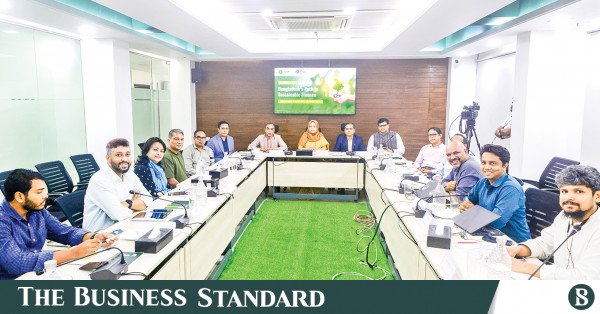
Speakers at a roundtable hosted by The Business Standard on Renewable energy.: Photo: TBS
“>

Speakers at a roundtable hosted by The Business Standard on Renewable energy.: Photo: TBS
Like the Covid recovery fund, the Bangladesh Bank should form a renewable energy fund of at least Tk10,000 crore with support from the national budget to reduce lenders’ risks, speakers said at a roundtable yesterday (23 August).
They stressed that the central bank alone cannot shoulder the burden of promoting sustainable financing in the country.
The government must step in with fiscal support, such as funds and incentives, and ensure the availability of credible data to scale up green energy and sustainability-linked projects.

The roundtable, organised jointly by Oxfam and The Business Standard under the former’s fair financing initiative, underscored the urgent need for large-scale financing to meet Bangladesh’s renewable energy ambitions.
Nurun Nahar, Deputy Governor, Bangladesh Bank. Photo: TBS
“>

Nurun Nahar, Deputy Governor, Bangladesh Bank. Photo: TBS
Nurun Nahar
Deputy Governor, Bangladesh Bank
She said the Sustainable Finance Department was established in 2016 and plays a vital role in achieving the SDGs. In 2024, the outstanding sustainable finance stood at Tk6.25 lakh crore, 26% of total loans, while Tk35,000 crore was disbursed for green financing.
She highlighted policies like green banking, green taxonomy, refinancing schemes, sustainable finance policy, and rating guidelines.
She stressed collective efforts, saying that without cooperation from government, banks, financial institutions, and active participation of stakeholders, sustainable finance targets cannot be achieved.
She said positive impacts can be ensured through reporting and policy integration and hinted at involving third-party institutions for investment monitoring.
Ashish Damle, Country director, Oxfam. Photo: TBS
“>

Ashish Damle, Country director, Oxfam. Photo: TBS
Ashish Damle
Country director, Oxfam
He said Bangladesh faces severe climate risks and disasters, creating an urgent need for investments in agriculture, infrastructure, and manufacturing.
Compared to others, it needs far more support due to its vulnerability. He stressed the need to build human capital, as the country lacks skilled talent and technology.
Current grants and loans are inadequate, and vulnerable nations should not rely on conventional debt but on compensation for climate damages. Intellectual property barriers hinder access to green technologies despite abundant resources.
He urged open access to such technologies and collaboration with government to create a global narrative on fairness and compensation.
Syed Mahbubur Rahman, Managing director, Mutual Trust Bank. Photo: TBS
“>

Syed Mahbubur Rahman, Managing director, Mutual Trust Bank. Photo: TBS
Syed Mahbubur Rahman
Managing director, Mutual Trust Bank
He said Bangladesh, though a low carbon emitter, is highly climate-vulnerable and requires billions for adaptation. With capital markets shallow, banks still provide 90–95% of industrial financing, but cannot bear the green transition alone.
He stressed large-scale funds through fiscal policies, with Bangladesh Bank focusing on regulation and credit lines.
He said banks face challenges as they rely on depositors’ money, which demands competitive returns, while green projects require 20–30% more investment without immediate gains.
Even green-certified RMG factories get no higher export prices, discouraging others. He called for government-led incentives, enforcement, and bottom-up energy policy, stressing data integrity and stronger governance.
Dr Suborna Barua, Chairman of International Business, Dhaka University. Photo: TBS
“>

Dr Suborna Barua, Chairman of International Business, Dhaka University. Photo: TBS
Dr Suborna Barua
Chairman of International Business, Dhaka University
He said Bangladesh has advanced in sustainable finance but fair financing is overlooked. Sustainability is meaningful only if rooted in fairness, based on equity, justice, inclusivity, impact, transparency, and accountability.
Any violation makes financing unjust, such as inequity or human rights abuse.
He emphasised third-party verification, as banks certifying their own projects creates conflicts of interest.
Poor data and weak disclosure remain barriers. Not all green projects are fair — costly solar excludes the poor, while microcredit is pro-poor but not green. He called for balancing fairness and green, avoiding both “green elitism” and “social policing.”
Mohammad Rafiqul Islam, Managing director, United Finance. Photo: TBS
“>

Mohammad Rafiqul Islam, Managing director, United Finance. Photo: TBS
Mohammad Rafiqul Islam
Managing director, United Finance
He pointed out the risks of green financing and said government fiscal policies must share responsibility, not leave it all to banks.
He highlighted weak data integrity and transparency as major problems. Real project data, environmental and social impact assessments, and ESG disclosures by banks are not consistently published.
He said despite having four indicators under the sustainable finance policy, accurate data is scarce, as many banks do not release reports on time. He added that political influence sometimes sidelines essential sectors. He emphasised better disclosure and data to align with global standards and improve investor confidence.
Nurul Alam Masud, CEO, PRAAN. Photo: TBS
“>

Nurul Alam Masud, CEO, PRAAN. Photo: TBS
Nurul Alam Masud
Chief executive officer, PRAAN
He stressed the challenges of fair and sustainable financing and the need for transparency and accountability. He said NBFIs like United Finance work more with small clients and outside Dhaka, though costs are higher, while banks focus mainly on big clients.
NBFIs show more interest in refinancing, unlike banks. He noted the new guarantee scheme covering SMEs and small businesses could strengthen green financing.
He argued financing must consider women and child rights, workers’ participation, fair wages, and environmental impact, not just profits. He urged Bangladesh Bank to publish due diligence, ESI/ESG, and community consultation reports to ensure accountability.
Doulot Akter Mala, President, The Economic Reporters Forum. Photo: TBS
“>

Doulot Akter Mala, President, The Economic Reporters Forum. Photo: TBS
Doulot Akter Mala
President, The Economic Reporters Forum
She said journalists can play a vital role in promoting sustainable finance, but data transparency remains a major barrier. Bangladesh Bank performs better in sharing information, but institutions like the NBR lag behind.
She called for inclusion of gender-based data in sustainable finance. She criticised the lack of empowerment of officials in the renewable energy sector and highlighted frustrations with dysfunctional solar projects due to battery shortages and infrastructural gaps for wind power.
She questioned why abundant natural resources are underused and pointed to poor coordination between fiscal and monetary policies. She said lack of transparency, coordination, and willpower block progress.
Mohammad Emran Hasan, Head of Climate Justice & Natural Resources Rights, Oxfam in Bangladesh. Photo: TBS
“>

Mohammad Emran Hasan, Head of Climate Justice & Natural Resources Rights, Oxfam in Bangladesh. Photo: TBS
Mohammad Emran Hasan
Head of Climate Justice & Natural Resources Rights, Oxfam in Bangladesh
To ensure the sustainable finance, we, from Oxfam in Bangladesh, works with Fair Finance initiative which supports to embed justice, transparency, and accountability into the heart of financial decision-making.
Through the initiate, we are challenging institutions to go beyond profit and prioritize people and the planet. Our work is rooted in evidence, equity, and inclusion. Sustainable finance must reflect the voices of those most affected—especially in energy, infrastructure, and garments—ensuring that no one is left behind in Bangladesh’s green transition
Mohammad Emran Hasan, Head of Climate Justice & Natural Resources Rights, Oxfam in Bangladesh. Photo: TBS
“>

Mohammad Emran Hasan, Head of Climate Justice & Natural Resources Rights, Oxfam in Bangladesh. Photo: TBS
Hasan Mehedi
Member secretary, Bangladesh Working Group on External Debt (BWGED)
He said Bangladesh Bank has taken many green and sustainable finance policies over the past decade. Recently, the government decided to generate 3,000MW through rooftop solar this fiscal year, requiring $2.4 billion within 10 months.
The revised Renewable Energy Policy 2025 targets 20% renewable energy by 2030 and 30% by 2040, needing $7.2 billion in five years. Financing remains a challenge as banks are reluctant to take risks.
He proposed a tripartite model: the government and Bangladesh Bank providing 25% as subsidy, banks 50% as loans, and prosumers covering 25%. He flagged lack of priority, weak transparency, taxonomy gaps, and global financing limits.
Md Sariful Islam, Head of Influencing, Communications, Advocacy & Media, Oxfam in Bangladesh. Photo: TBS
“>

Md Sariful Islam, Head of Influencing, Communications, Advocacy & Media, Oxfam in Bangladesh. Photo: TBS
Md Sariful Islam
Head of Influencing, Communications, Advocacy & Media, Oxfam in Bangladesh
He said the lack of economic education in Bangladesh has left people unaware of the importance of financial data and its role in advocacy at national and international levels.
This gap also weakens the understanding of climate finance. He stressed that Bangladesh must present itself globally with data-based evidence, as a climate-vulnerable country.
Data use should be taught from primary to higher education. Regulatory bodies must make necessary data publicly accessible so people can grasp its significance.
He added that climate change causes not only infrastructural damage but also social and psychological harm, which is why climate finance should not be seen merely as debt.
Dabaraj Dey, Head of PMU, Oxfam Bangladesh. Photo: TBS
“>

Dabaraj Dey, Head of PMU, Oxfam Bangladesh. Photo: TBS
Dabaraj Dey
Head of PMU, Oxfam Bangladesh
He highlighted the need for fair financing and pointed to policy weaknesses. Financing, he argued, must not only prioritise financial returns but also include justice-based approach including human rights, marginalised communities’ participation, and long-term environmental impacts.
He said any infrastructure, garments, or power projects must reflect the voices of marginalised groups, which should be built into green banking policy and environmental risk guidelines.
He emphasised locally led adaptation and the use of indigenous technologies, questioning why local expertise has been underutilised. He urged adopting a “life-cycle approach,” covering impacts, waste management, and post-demolition phases from start to finish.
Dr Kazi Maruful Islam, Professor, Department of Development Studies, Dhaka University. Photo: TBS
“>

Dr Kazi Maruful Islam, Professor, Department of Development Studies, Dhaka University. Photo: TBS
Dr Kazi Maruful Islam
Professor, Department of Development Studies, Dhaka University
He said the Ministry of Finance must be held accountable for fair implementation of tax and subsidy policies. Bangladesh Bank should proactively, not reactively, assess banks’ environmental and social impacts and monitor financial flows.
Green projects are not always fair — for example, costly solar power excludes the poor, while microcredit is fair but not always green. He urged avoiding both “green elitism” and “fairness without greenness” through an integrated model. Sustainability and fairness, he added, are political as well as economic, and must also be reflected in tax, industry, and investment policies.
He stressed third-party auditing to verify data instead of banks claiming success themselves.