
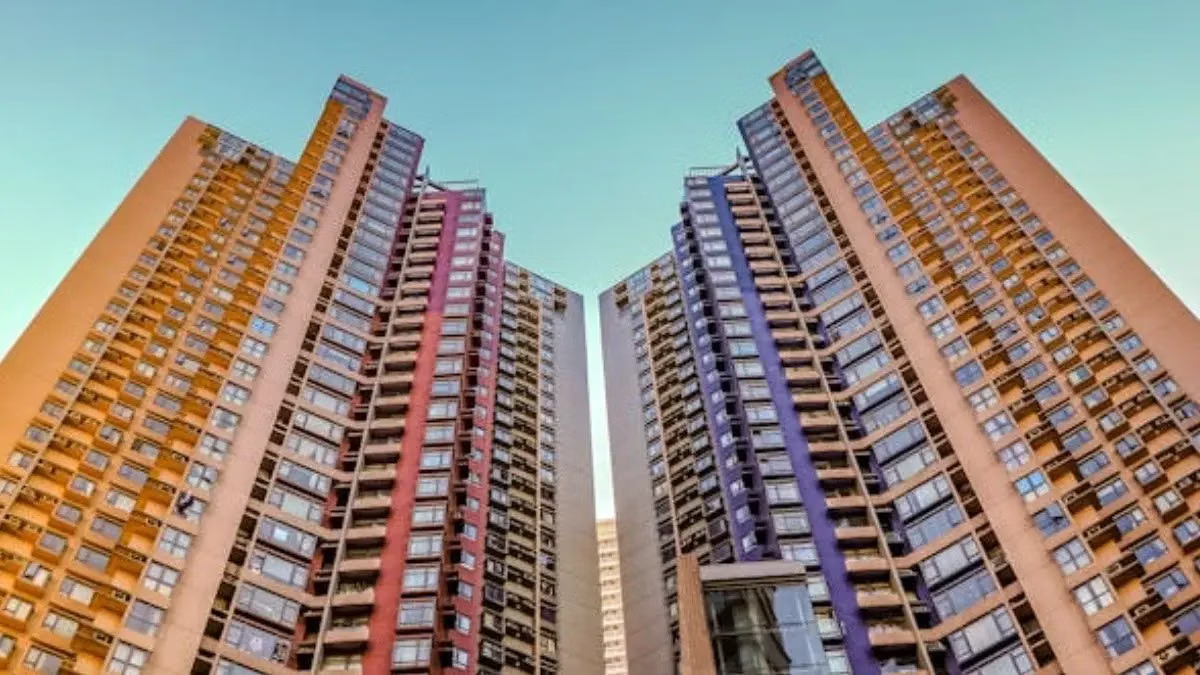

Representational Image | Image:
Pexels
Mumbai’s property market has reclaimed its pre-pandemic investment strength, with institutional inflows crossing USD 1.2 billion in the first nine months of 2025, according to Cushman & Wakefield’s India Capital Markets Q3 2025 report. This marks the fourth consecutive year the city has exceeded the billion-dollar benchmark, reaffirming its position as India’s leading gateway market for both global and domestic investors.
At the national level, institutional real estate investments—spanning private equity and REITs—touched USD 4.7 billion in the year to September, reflecting sustained investor confidence. The report projects total inflows to close between USD 6–6.5 billion by year-end, potentially making 2025 the second-highest investment year on record for India’s real estate sector.
A notable trend is the rising participation of domestic investors, who now account for 48% of total inflows between January and September, compared with a smaller share in previous years. Foreign capital made up 52%, creating a balanced investment mix that has reduced dependency on cross-border flows.
Office assets remained the preferred investment category (35% of YTD inflows), followed by residential (26%), retail (12%), and logistics and industrial (9%) segments.
“India’s real estate investment landscape continues to show remarkable resilience and depth. Even amid global uncertainty, institutional capital has found stability in India’s strong fundamentals and governance frameworks,” said Somy Thomas, Executive Managing Director, Capital Markets, Cushman & Wakefield. “The growing participation of domestic investors underlines the market’s maturity and long-term confidence,” he added.
In Mumbai, foreign capital contributed nearly two-thirds (67%) of total inflows, amounting to USD 797.7 million, led by investors from the United States (USD 500 million) and Japan (USD 297 million). Domestic investors added another USD 398 million, strengthening the market’s capital diversity.
Investment activity was spread across multiple asset classes. The residential sector led with USD 377.6 million—largely from redevelopment projects—while the office segment followed with USD 339.7 million, buoyed by resilient occupier demand. The logistics and industrial segment attracted USD 269.3 million, highlighting its growing institutional appeal, while mixed-use commercial projects drew USD 155 million and data centers received USD 54.6 million, signaling expanding investor interest beyond traditional categories.
Mumbai’s continued investment momentum is underpinned by its infrastructure transformation, with major projects such as the Mumbai Trans Harbour Link (Atal Setu), Coastal Road, Metro network expansion, and the Navi Mumbai International Airport reshaping connectivity and unlocking new growth corridors.
> “Mumbai’s investment story has come full circle, returning to pre-pandemic levels and sustaining its billion-dollar streak,” said Somy Thomas.
“Infrastructure-led growth and a diversified asset base continue to drive investor confidence. We expect this momentum to gain further pace in the coming months,” he noted.