
Close Menu
Finance Pro
  • Home
  • Art Gallery
  • Art Investment
  • Art Stocks
  • Cryptocurrency
  • Finance
  • Investing in Art
  • Investments
Facebook X (Twitter) Instagram
Trending
  • Finance professionals say the AI skills gap is widening
  • #CryptoCornerSeason2 | Sigma Capital’s Vineet Budki To CNBC-TV18 – Most investors seem to be in a wait and watch mode – Investors should evaluate and invest in cryptocurrencies on declines Manisha Gupta | Binance #CNBCTV18Market #Cryptocurrenc – LinkedIn
  • What They Are and How To Choose
  • Funding secured to reopen galleries at Birmingham Museum & Art Gallery
  • The true cost of owning a priceless painting- The Week
  • Embedded Finance vs Banking as a Service in 2026: Key Differences Explained
  • Cryptocurrency Exchanges: The Gateway To Global Crypto
  • Outlook India – India’s Best Magazine
  • Privacy Policy
  • Terms and Conditions
  • Get In Touch
Finance ProFinance Pro
  • Home
  • Art Gallery
  • Art Investment
  • Art Stocks
  • Cryptocurrency
  • Finance
  • Investing in Art
  • Investments
Finance Pro
Home»Art Gallery»How Black Women Ceramicists Shaped Art History
Art Gallery

How Black Women Ceramicists Shaped Art History

September 30, 20255 Mins Read


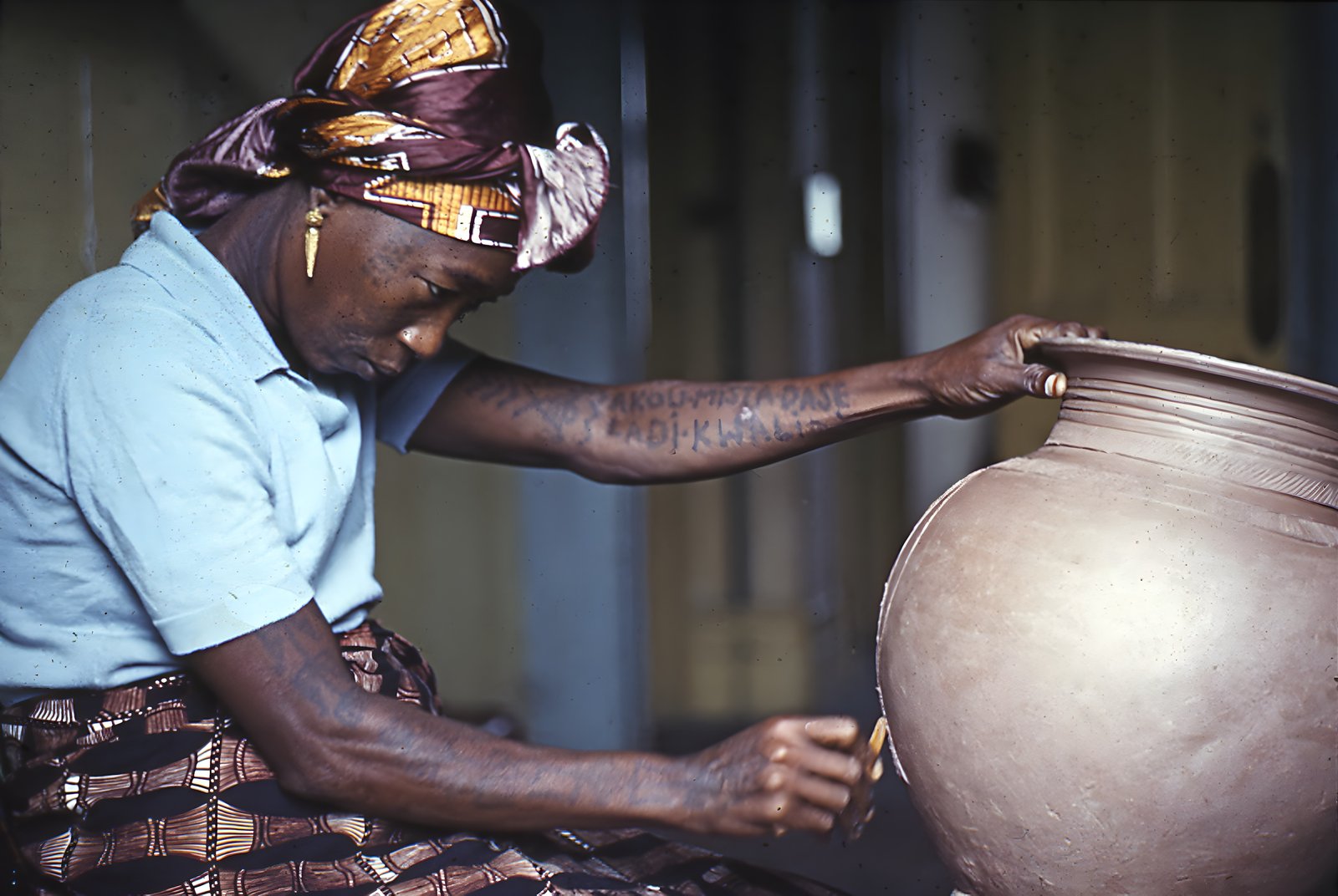
An exhibition at the Ford Foundation Gallery captures how Black women artists mold clay and, through their labors, shape art history itself. Body Vessel Clay: Black Women, Ceramics & Contemporary Art, which spans three generations of artists, begins with Ladi Dosei Kwali. Born in 1925, the artist created water pots between the 1950s and the ’70s in Abuja, Nigeria, connecting the intimacy of household vessels with the broader recognition of clay as an artistic medium. Each of the three water pots, produced from 1959 to 1962, is formed through a traditional coil method and then burnished, resulting in a soft, earthy sheen. In the first gallery, these objects are contextualized by archival photographs and publications documenting Nigerian pottery and Kwali’s career, underscoring how her practice was locally rooted and globally recognized.  

Kwali’s unique process emerged from indigenous Gwari pottery techniques she learned in her youth. Later, at the Abuja Pottery Centre, she developed them into a distinctive blended style. There, she learned modern studio techniques — decorative glazing, modern kiln firing, and potter’s wheel experimentation — while remaining rooted in the tactile labor of hand-formed clay. As the first woman to study and thrive at the pottery training center, Kwali paved the way for Black women artists around the world to succeed.

Installation view of Sylvia Leith-Ross’s book Nigerian Pottery (1970) and a copy of Nigeria Magazine (1961) in Body Vessel Clay: Black Women, Ceramics & Contemporary Art at the Ford Foundation Gallery (photo Alexandra M. Thomas/Hyperallergic) 

The second half of the exhibition highlights ceramics created by the legatees of Kwali’s influence. Whereas Kwali entered the center as an already accomplished village potter, Halima Audu belonged to a younger generation of trainees. Her jar from 1959, with its dark, glossy glaze and sharply carved geometric patterning, demonstrates how she and others carried local hand-building traditions into a modern studio context. Displayed alongside it, Magdalene Odundo’s 1979 matte surfaced pot, accented with rounded cuts that echo the pot’s contours, integrates this lineage with a new sculptural language. Later works by Odundo, placed at the back of the gallery, showcase her signature tall-necked vessels featuring tilted rims that emphasize their bold silhouette and the play between curve and balance. 

Contemporary artists such as Simone Leigh and Adebunmi Gbadebo follow in this tradition. Leigh cites Kwali and Odundo among the artists who inspire her ongoing practice as a sculptor. In the corner of the gallery, on the floor, sits Leigh’s domed “Village Series” stoneware sculpture (2023–24). The raised, plait-like surface evokes Black women’s braiding traditions, transforming the visual form into a monumental expression. Nearby, Gbadebo’s “Sam” (2023) is shaped from soil gathered at True Blue Plantation in South Carolina — where her maternal ancestors were enslaved — and edged with tufts of Black hair pressed into the pieces. The experimental pot becomes a memorial to land and body, inheritance and loss. 

Installation view of Body Vessel Clay: Black Women, Ceramics & Contemporary Art at the Ford Foundation Gallery. Pictured: Phoebe Collings-James, “Infidel (Scorpion),” “Infidel (knot song),” and “Infidel (virtuosic)” (all 2025), glazed stoneware ceramic (photo Alexandra M. Thomas/Hyperallergic)

On the floor nearby are works from Phoebe Collings-James’s Infidel series (2025). Known for using clay to confront themes of vulnerability, refusal, and power, she presents tilted, abstracted figures with narrow necks and slanted mouths. Their fragile balance makes them feel both delicate and defiant.

Nontsikelelo Mutiti’s graphic wall at the entry and exit presents a field of repeating geometric patterns that sets the rhythm of the exhibition. The design parallels the textured clay surfaces of the vessels, where ridges, grooves, and contours register the labors of the artists’ hands. These marks are not merely decoration but traces of process and presence — records of Black women’s expertise and experimentation with clay. Beginning with Kwali’s pots, through the works of Audu, Odundo, Leigh, Gbadebo, and other contemporary artists in the second gallery, the exhibition demonstrates how Black women’s ceramics embody continuity, carrying histories across generations. 

Simone Leigh, stoneware sculpture from Village series (2023–24) (photo Alexandra M. Thomas/Hyperallergic)
Installation view of the entrance to Body Vessel Clay: Black Women, Ceramics & Contemporary Art at the Ford Foundation Gallery (photo Sebastian Bach)
Adebunmi Gbadebo, “Sam” (2023), soil sourced from the True Blue Plantation in South Carolina, human hair, pit-fired (photo Alexandra M. Thomas/Hyperallergic)
Installation view of performance documentation by Chinasa Vivian Ezugha in Body Vessel Clay: Black Women, Ceramics & Contemporary Art at the Ford Foundation Gallery (photo Sebastian Bach)
Magdalene Odundo, “Symmetrical Reduced Black Narrow-Necked Tall Piece” (1990), terracotta (image courtesy Brooklyn Museum)
Ladi Kwali, “Unglazed pot from Farnham demonstration” (1962), earthenware (image courtesy Crafts Study Centre, University for the Creative Arts)

Body Vessel Clay: Black Women, Ceramics & Contemporary Art continues at the Ford Foundation Gallery (320 East 43rd Street, Midtown, Manhattan) through December 6. The exhibition was curated by Jareh Das. 


Source link

Share. Facebook Twitter Pinterest LinkedIn Tumblr Email

Related Posts

Funding secured to reopen galleries at Birmingham Museum & Art Gallery

April 10, 2026 Art Gallery

Leonard McComb exhibition at Wirral gallery later this year

April 9, 2026 Art Gallery

THE WILSONS’ ART GALLERY IS WHERE THE WILD THINGS ARE

April 9, 2026 Art Gallery

Settle’s Gallery on the Green re-opens with ‘Gilding the Letter’

April 9, 2026 Art Gallery

Robilant and Voena gallery founders part ways to start separate ventures with their children – The Art Newspaper

April 9, 2026 Art Gallery

Marlborough art gallery to open exhibition of rare artwork

April 8, 2026 Art Gallery
Add A Comment
Leave A Reply Cancel Reply

Don't Miss

Finance professionals say the AI skills gap is widening

April 10, 2026 Finance 2 Mins Read

A close-up image shows a computer chip labeled “AI” connected to a circuit board illuminated…

#CryptoCornerSeason2 | Sigma Capital’s Vineet Budki To CNBC-TV18 – Most investors seem to be in a wait and watch mode – Investors should evaluate and invest in cryptocurrencies on declines Manisha Gupta | Binance #CNBCTV18Market #Cryptocurrenc – LinkedIn

April 10, 2026

What They Are and How To Choose

April 10, 2026

Funding secured to reopen galleries at Birmingham Museum & Art Gallery

April 10, 2026
Our Picks

Finance professionals say the AI skills gap is widening

April 10, 2026

#CryptoCornerSeason2 | Sigma Capital’s Vineet Budki To CNBC-TV18 – Most investors seem to be in a wait and watch mode – Investors should evaluate and invest in cryptocurrencies on declines Manisha Gupta | Binance #CNBCTV18Market #Cryptocurrenc – LinkedIn

April 10, 2026

What They Are and How To Choose

April 10, 2026

Funding secured to reopen galleries at Birmingham Museum & Art Gallery

April 10, 2026
Our Picks

#CryptoCornerSeason2 | #Crypto Prices Inch Higher – Total cryptocurrency market cap rises 1.80% in March – #Bitcoin and #Ethereum gain despite broader market weakness Binance India Seker -. @mani.0711 #CNBCTV18Market #Cryptocurrency #Binance – LinkedIn

April 9, 2026

THE WILSONS’ ART GALLERY IS WHERE THE WILD THINGS ARE

April 9, 2026

Settle’s Gallery on the Green re-opens with ‘Gilding the Letter’

April 9, 2026
Latest updates

Finance professionals say the AI skills gap is widening

April 10, 2026

#CryptoCornerSeason2 | Sigma Capital’s Vineet Budki To CNBC-TV18 – Most investors seem to be in a wait and watch mode – Investors should evaluate and invest in cryptocurrencies on declines Manisha Gupta | Binance #CNBCTV18Market #Cryptocurrenc – LinkedIn

April 10, 2026

What They Are and How To Choose

April 10, 2026
Weekly Updates

Firetrail Investments Reduces Stake in Nufarm

June 24, 2024

4 Key Concepts and Strategies From a Finance Professor

August 27, 2024

The arts matter. So do we!

March 26, 2024
  • Privacy Policy
  • Terms and Conditions
  • Get In Touch
© 2026 Finance Pro

Type above and press Enter to search. Press Esc to cancel.