

[ad_1]
The National Gallery has acquired After the Audience by the British Dutch-born painter Sir Lawrence Alma-Tadema (1836 –1912) for £2 million – the third picture to be secured by the Gallery to mark its 200th anniversary year.
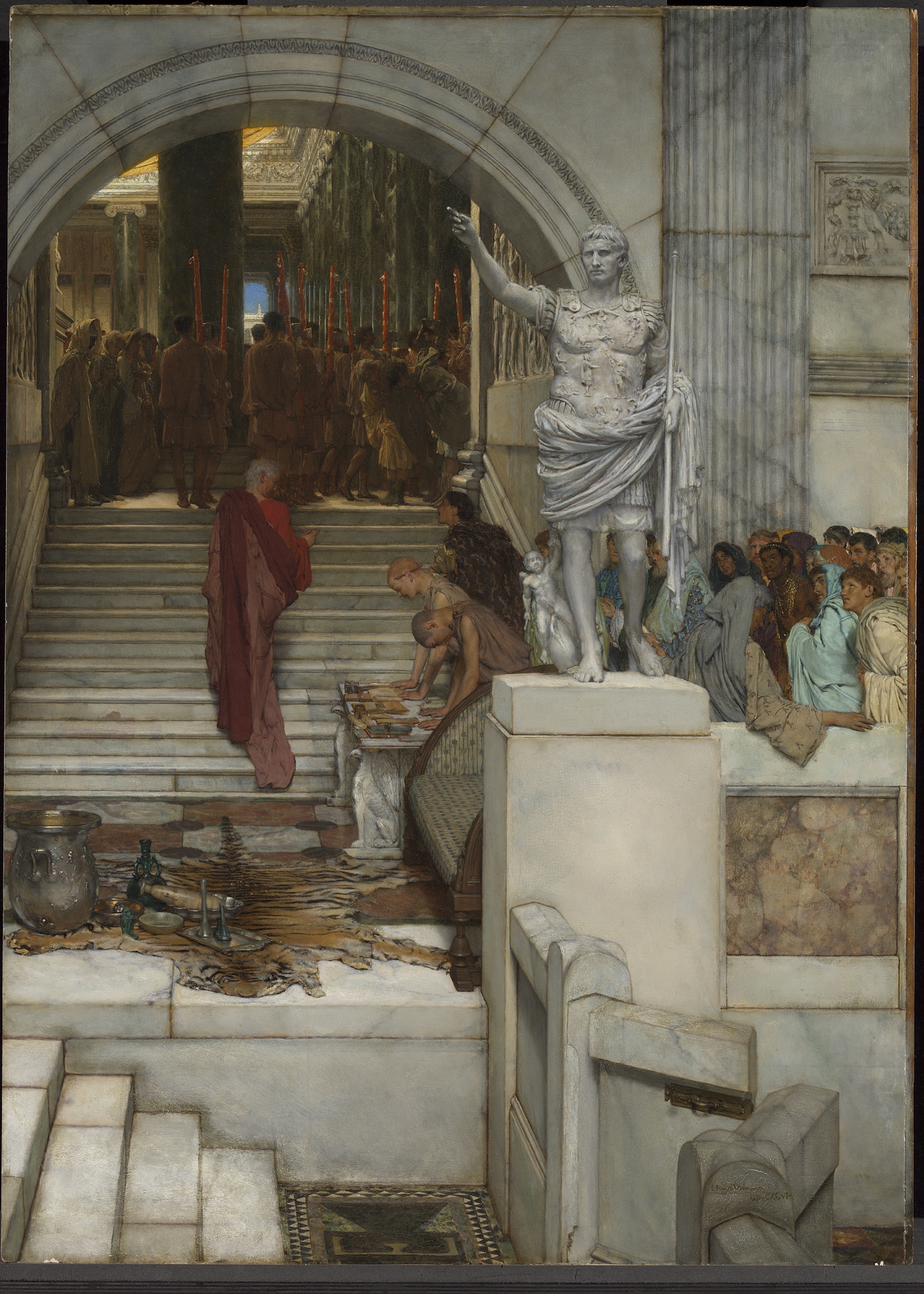
This painting by Alma-Tadema is striking in terms of scale, subject and ambition, particularly among the artist’s earliest work, executed in the UK. It is the only work by the artist in the National Gallery’s collection and goes on display in Room 45.
Inspired by Ancient Rome, the picture depicts Agrippa, son in law of the Emperor Augustus, as he mounts the stairs of his villa after receiving petitioners from all corners of the Empire. Their gifts to him are laid out in the foreground. After the Audience was acquired from a private collection in negotiations brokered by Christie’s Private Sales. The purchase has been made possible thanks to the legacies of Mrs Martha Doris Bailey and Mr Richard Hillman Bailey, Miss Gillian Cleaver, and Ms Sheila Mary Holmes, and the support of the National Gallery Trust, 2024. The acquisition represents both Neoclassicism and Aestheticism, two important artistic movements within the Western tradition that have largely been unrepresented at Trafalgar Square from the mid-20th century.
?Alma-Tadema was one of the most popular Victorian painters, admired during his lifetime for his accurate depictions of Classical antiquity, but his work fell out of fashion after his death, and only since the 1960s has it been appreciated for its importance within 19th-century painting.
After the Audience was considered by his contemporaries and by later experts in Victorian painting to be one of Alma-Tadema’s masterpieces from the first decade after he settled in London. It was painted to impress Sir William Armstrong, the wealthy Newcastle engineer and industrialist, who had admired the artist’s earlier work, An Audience with Agrippa, now in the Dick Institute, Kilmarnock, East Ayrshire, Scotland, when it was exhibited to great acclaim at the Royal Academy in 1876. Although the precise details of the commission are unclear, it is known that Armstrong was keen to buy a similar composition for his collection. However, Alma-Tadema chose instead to depict the moment at the end of the audience, rather than the beginning, with the key figure of Agrippa ascending the stairs of his impressive villa and away from the petitioners and objects assembled on the landing below.
?Although comparable in scale and broadly similar in composition, particularly the architectural setting and the prominence of the statue, this second version is considerably more complex, populated and ambitious than that of the first. Although paired scenes, showing related narratives of ‘before and after’ a single event, were sometimes deployed by artists at this time, Alma-Tadema may simply have taken the opportunity presented by Armstrong’s patronage to improve on a successful formula. Even so, Armstong seems to have taken such substantial amendments as a personal slight and decided not to purchase the painting. It was, however, very well received when it was first exhibited at the Royal Scottish Academy in 1879.
The main protagonist of After the Audience is Marcus Vipsanius Agrippa, the general, statesman and architect who was a close friend, son-in-law and lieutenant to Augustus Caesar, who reigned as the first Roman Emperor from 27 BC. Agrippa was also the financier of Augustus’s programme of constructing notable buildings, including the Pantheon, the Basilica of Neptune, the baths of Agrippa, and numerous aqueducts and sewers.
After the Audience is the third of the Gallery’s NG200 acquisitions this year, following Poussin’s Eucharist and The Full-length Mirror by Eva Gonzalès.
Dr Gabriele Finaldi, Director of the National Gallery, says:
We continue to celebrate our 200th anniversary with our third acquisition this year. We can now represent in our collection the Dutch artist Lawrence Alma-Tadema, who, after settling in London became a very important figure in the British art world of the late-19th century. We are grateful to the legacies of Martha Doris Bailey and Richard Hillman Bailey, Gillian Cleaver, and Sheila Mary Holmes, with the support of the National Gallery Trust, for enabling us to buy this outstanding picture.
Sir Lawrence Alma-Tadema (1836-1912) After the Audience, 1879 was bought for £2 million thanks to generous legacies from Mrs Martha Doris Bailey and Mr Richard Hillman Bailey, Miss Gillian Cleaver, and Ms Sheila Mary Holmes, with the support of the National Gallery Trust, 2024.
About the artist
Born in Friesland, the Netherlands, Lawrence Alma-Tadema OM, RA, RWS (1836-1912) attended the Academy of Fine Arts in Antwerp where he trained with the history painter Gustave Wappers (1803-1874). At the age of 16, he became an assistant to Louis Jan de Taeye (1822-1890), who advocated historical accuracy and an appreciation for depicting scenes from the Ancient World, both of which became key traits in Alma-Tadema’s work. He then joined Jan August Hendrik Leys (1815-1869), whose studio was one of the most highly regarded in Belgium at the time. Under Leys’ critical eye, Alma-Tadema improved and refined his skills, becoming especially adept at representing materials and textures such as hard metals and stone surfaces. His earliest major work The Education of the Children of Clovis (1861, private collection) was well received by critics and the public, eventually being presented to King Leopold of Belgium.
Alma-Tadema first visited Italy on his honeymoon in 1863. Having focused previously on Merovingian and Egyptian subjects, his extensive tour and study of Roman sites, particularly the impressive ruins and fresco decorations of Pompeii and Herculaneum, proved to be a turning point in his career. The following year he won a gold medal at the Paris Salon and during that summer he met the influential London dealer and print publisher Ernest Gambart (1814-1902) who immediately recognised the young artist’s extraordinary talent and subsequently commissioned and exhibited work by him.
It was during his first trip to London in 1869 that Alma-Tadema became acquainted with the British painter Ford Madox Brown (also a former student of Gustave Wappers) and his wide circle of artists. After the outbreak of the Franco-Prussian war in 1870, Alma-Tadema decided to relocate permanently to the UK, in part (as he later noted) because London was ‘the only place where, up till then my work had met with buyers.’ By 1871, he had befriended many of the prominent Pre-Raphaelite painters, with whom his work was often associated, not least because he was influenced by their use of bright colours. However, while his meticulous attention to detail and meaningful subject matter also chimed with the Pre-Raphaelite ethos, his focus on Greek and Roman themes bears greater comparison with the Academicism and Classicism adopted by the British artists Frederic Leighton (1830-1896) and John William Waterhouse (1849-1917, see fig.4) and the Frenchman Jean-Léon Gérôme (1824-1904). Indeed, like Leighton and Waterhouse, Alma-Tadema was able to bridge the established trend of Neoclassicism with a fresh Aesthetic influence, and it was his deftness in combining these two distinct artistic modes that undoubtedly contributed to his growing reputation. Furthermore, his compositions not only re-imagined and reanimated the past (and indeed archaeological sites like Pompeii) for his first audience, but also suggested a continuity between the Ancient and the Modern; between old and new empires.
By any measure, Alma-Tadema had a long and highly successful career, earning great sums as well as receiving accolades such as the Medal of Honour at the Paris Exposition Universelle of 1889. In his adopted country (he became the last officially recognised denizen of the UK in 1873), he rapidly ascended through the Victorian art establishment, becoming an Associate of the Royal Academy in 1876 and a full member in 1879, the year After the Audience was painted. In 1899 he was knighted, the eighth Continental artist to receive this honour, and the Order of Merit in 1905. After his death in 1912 a memorial exhibition was held at the Royal Academy, London. Beyond the fine art world, Alma-Tadema himself designed costumes, props and sets for the celebrated actor-manager, Sir Henry Irving, and made a life-long study of classical antiquities and architecture. This led to his paintings being used as source material during the 20th century by Hollywood directors, from Cecil B. DeMille to Ridley Scott, for their Biblical and Classical epics, such as Gladiator (2000, dir. Ridley Scott,) an area explored (specifically his influence on early cinema) in exhibitions such as Lawrence Alma-Tadema: At Home in Antiquity (Österreichische Galerie Belvedere, Vienna, 2016 and Leighton House Museum, London, 2017).
Categories
Tags
[ad_2]
Source link