
[ad_1]
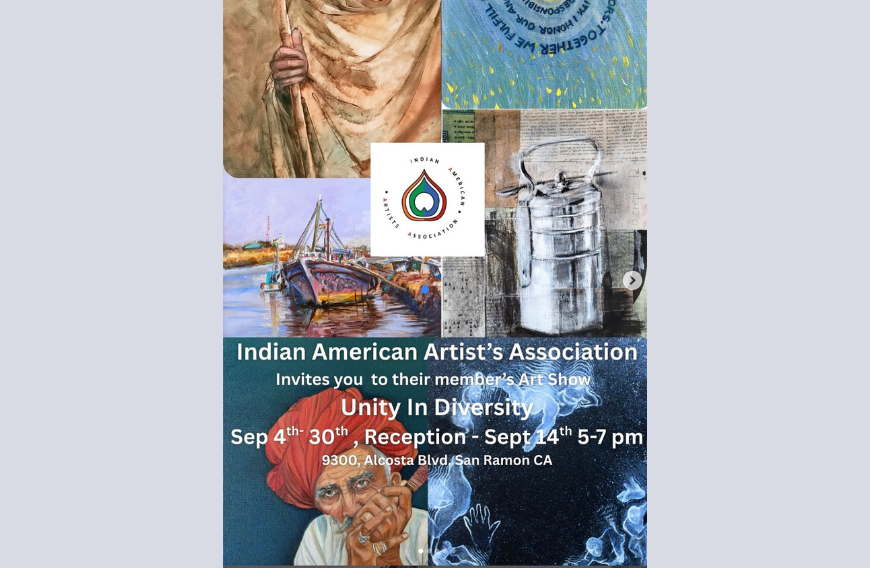
In the sunny city of San Ramon, California, a group of Indian American artists just unveiled a timely and ambitious exhibition titled “Unity in Diversity.” Conceptualized by the Indian American Artists Association (IAAA)—a collective formed to promote and support Indian and indigenous art in America—the showcase brings together painters, sculptors, and multimedia creators from across the country. On the surface, the exhibit featuring everything from eastern spirituality to western techniques looks like a perfect celebration of heritage, amalgamation, and creativity. But at a deeper level, it is also an economic statement, built around the idea that Indian art is not only socially resonant but can also be a rising force in the marketplace.
The timing of this couldn’t have been more pertinent. The art market in America, despite the otherwise economic slowdown, has been showing ascending signs. The arts and cultural sector grew at more than twice the rate of the total economy between 2022 and 2023, according to new data from the Arts and Cultural Production Satellite Account (ACPSA). In 2023, the most recent year for which data are available, arts and culture surpassed its annual value and added $1.2 trillion to the U.S., representing 4.2 percent of the nation’s GDP.
Some Indian artists have carved an enviable niche within the storied echelons of U.S. auctions. Nowhere is this more evident than in New York, which has become the epicenter of record-breaking sales for South Asian modern masters. 2024 saw Christie’s selling a painting by the late M.F. Husain for $13.8 million, setting a new record high for a modern Indian artist.
“Gestation” by Sayed Haider Raza fetched a hammer price of $5.4 million, while a 1937 work by Indian artist Amrita Sher-Gil fetched more than $7.4 million at a Saffronart auction in 2023.
If we were to put this into perspective, can we assume that the average hammer price for Indian modernists is rapidly rising? And even though these preponderant valuations still trail blue-chip names like Warhol or Rothko, for many Indian contemporaries, there are signs that it is possible to see the transformation of Indian art from a niche category into an increasingly credible segment of the international art economy.
READ: Small brands, big burden: How US tariffs on India are squeezing small businesses (
Sujata Tibrewala, one of the co-founders of IAAA, and one of the participating artists at the “Unity in Diversity” exhibit in Bay Area says, “Art spaces and events such as these are meant to have a two-pronged approach – one to showcase Indian art to the local American population that may have known Indian artforms only at a surface level and another to open the dialogue on even though the creative economy in America accounts for 5.4 million jobs as per latest data, why is it that Indian American artists remain largely at the margins of this booming ecosystem, with limited access to institutional funding, collector networks, or the multi-billion-dollar investment channels that could catapult their work into the mainstream.”
Bridging the gap
For a long time, Indian artists in the West have been bringing unique cultural nuances, ranging from folklore, Mughal miniature paintings, and temple-inspired iconography, into their art. Often the art is interestingly fused with expressionism, realism, and pop art—common themes seen in Western art. These artistic alignments, where immigrant creators fuse the ancient with the modern and the narratives of migration with those of homeland, serve not only as palimpsests of history but also expand and enrich mainstream American aesthetics.
Yet, many participating artists argue that these resonances are not fully understood by American audiences, and institutions do little to inform the audience about the intellectual depth and cultural continuity of immigrant art. San Jose-based artist Majella Pinto showcased paintings that explore representational realism at the exhibit and says, “Most of the Indian-origin artists I know in the Bay Area, though deeply passionate about their craft, also maintain day jobs to ensure financial stability, largely because art alone does not guarantee a sustainable income.”
Pinto believes a wider acceptance would follow after Indian American audiences take a deeper interest in visual arts. She says, “South Asians in general tend to invest more in STEM-related fields and do not hold art education or art curation with the same enthusiasm.” She adds, “Often, American gallerists have told me when they felt my work was underpriced and have been willing to pay more when they believed the art deserved it. That kind of respect, she laments, is still rare within South Asian circles when it comes to valuing art and artists.”
Indian art — an unrealized soft power
Artist Amita Bhakta, who traveled from Florence, North Alabama, to be part of the exhibition, feels that Indian art has immense potential and can act as a soft power to address volatile global issues if the curators were to look at the messaging behind the art. She says, “In the U.S., there are frequent calls for Hispanic and African artists, which is wonderful, but it is disheartening that similar platforms almost never exist for Indian artists. Our visibility is still far behind.”
READ: Jane Street accused of market manipulation by Indian authorities (
This lack of representation, she argues, doesn’t just limit cultural presence; it also keeps Indian-origin art from tapping into the networks of collectors, institutions, and investors that drive real growth in the creative economy.
Tibrewala, who is also a docent at the San Jose Museum of Art, also sees a greater need to educate audiences about Indian art. Keeping this in mind, she recently held a two-day course at Santa Clara University on ancient and colonial Indian art and its influence globally. She says, “Often when audiences visit an Indian artists’ exhibit, they are taken aback by the panorama of subjects we showcase.”
Talking about her showcased work at the exhibit, Quantum Connection, she says, “My painting explores atoms, the fundamental building blocks of the universe and of ourselves. At their core, atoms are nothing more than packets of energy, connecting us to the cosmos. Curators often tell me this comes as a refreshing surprise, since they arrive expecting mythology or bursts of color. I remind them that while those traditions are indeed part of our strength, Indian-origin artists are equally powerful voices in modernism, cubism, and in exploring the intersections of art and science.”
Another exhibiting artist, Salma Arastu, who showed her work titled “Mycelial Flow,” agrees with the diversity in the work of South Asian artists. She says, “My work reflects contemporary ecological and social issues, drawing on science, spirituality, and the humanities,” inspired by forest ecology and the mycelial networks that sustain life beneath the soil.
“Interestingly, whenever I’ve showcased my work, I’ve found a genuine willingness among collectors to invest in these themes when expressed by Indian artists as well. What we truly need now,” she adds, “is broader outreach, ways to make Indian art more visible and accessible within the American art landscape.”
[ad_2]
Source link