
[ad_1]
Legislation currently making its way through Congress that proponents say will place much-needed guardrails on cryptocurrency will only exacerbate the industry’s insatiable energy demands and climate pollution, environmentalists say.
Republican leaders in the U.S. House of Representatives declared this week to be “Crypto Week,” during which they hope to pass several bills related to cryptocurrency. Chief among them is the Guiding and Establishing National Innovation for U.S. Stablecoins Act, or GENIUS for short.
The bill has bipartisan support, including from U.S. Sens. Kirsten Gillibrand (D-N.Y.) and Cory Booker (D-N.J.), who say the legislation, which passed the Senate in June, will provide key safety measures for consumers and financial markets.
President Donald Trump, no stranger to crypto with his own $TRUMP meme coin and an estimated $1 billion in crypto holdings, announced Tuesday evening on Truth Social that he convinced House GOP crypto holdouts to vote in favor of the bill.
While some economists say the GENIUS Act will have the opposite effect of its intended goals, bringing economic chaos and the next global financial crisis, environmental advocates say the bill will supercharge a destructive industry no matter its impact on the financial system.
“The more that crypto currency generally is legitimized and used, the more crypto mining there will be,” said Mandy DeRoche, deputy managing attorney for Earthjustice’s clean energy program.
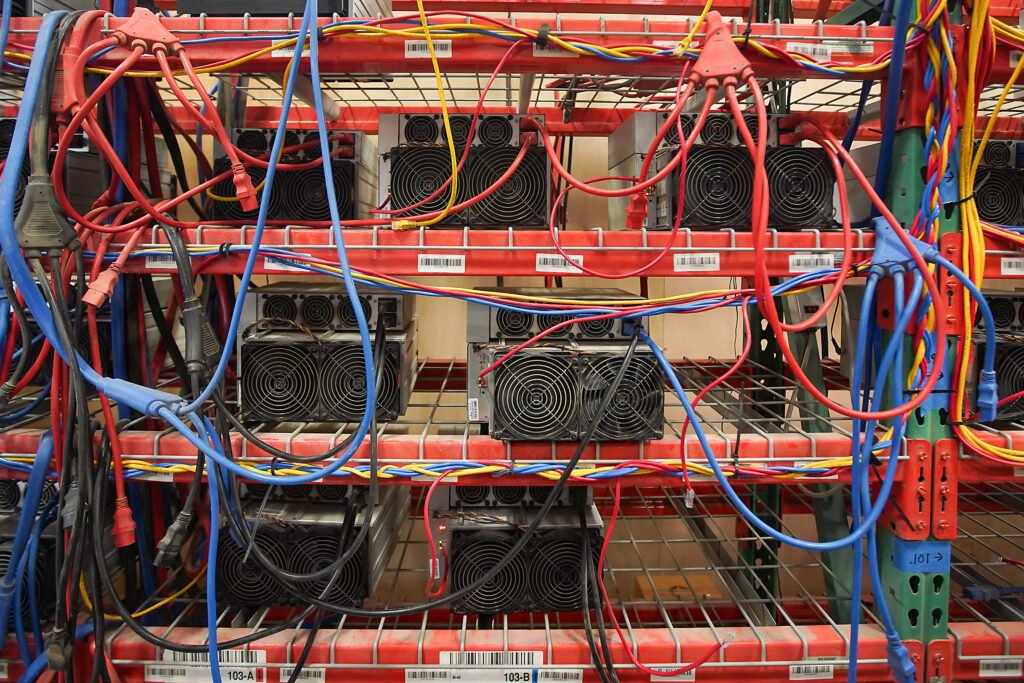
Mining is the most common method for authenticating or generating new cryptocurrency, such as Bitcoin. It involves powerful computers that work around the clock running endless series of random numbers before hitting upon the correct code. Every time a Bitcoin miner’s computer successfully guesses a transaction code, the miner receives a limited number of newly minted Bitcoins.
As both cryptocurrency’s popularity and the complexity of its codes for new coins have grown, the industry’s energy demands have skyrocketed.
As much as 2.3 percent of all U.S. electricity consumption went to cryptocurrency mining in 2022, according to the federal Energy Information Administration.
Many of the mines are sited in small towns and rural areas.
“They’re billion-dollar corporations that just come in, bully [and] steamroll local communities,” said Jackie Sawicky of the National Coalition Against Cryptomining. “There’s almost no oversight.”
Water use and noise complaints from large mines face increasing backlash in Texas, which leads the country in Bitcoin mining.
However, another method exists to authenticate cryptocurrency that doesn’t involve mining and its associated environmental concerns. Known as proof of stake, the method relies on validators, individuals who already have a significant amount of, or stake in, a given cryptocurrency, who check the transactions used to generate the new currency. Validators earn transaction fees for their work and agree to freeze a portion of their own stake during the verification process to ensure they work honestly.
Ethereum, the second largest cryptocurrency after Bitcoin, saw a 99.99 percent drop in its energy usage after switching from mining, also known as proof of work, to proof of stake verification in 2022.
The GENIUS Act seeks to regulate stablecoin, a type of cryptocurrency that is tied to the value of another asset, such as the U.S. dollar, to reduce price volatility.
New stablecoin can be verified either through mining or by proof of stake. The GENIUS Act doesn’t set any requirements on how new stablecoins are minted.
Neither Gillibrand’s nor Booker’s office responded to a request for comment about the continued allowance for cryptocurrency mining under the GENIUS Act.
Most cryptocurrency, including Bitcoin, which controls more than 60 percent of the global crypto market, relies on mining. Environmental advocates say any growth in the industry through stablecoin will simply drive additional mining.
Amanda Wick, the founder and chief executive officer of the Association for Women in Cryptocurrency, said in an interview with C-SPAN on Wednesday that the majority of stablecoins are minted through mining.
However, it doesn’t have to be that way, said Adi Wolfson, a researcher at the Shamoon College of Engineering in Israel. He recently published a study on the sustainability of stablecoin relative to other cryptocurrencies. Mining them has just as large a footprint as other cryptocurrency, he said, but producing them via proof of stake means “less energy, less pollution, less carbon.”
“You have here the opportunity to choose,” Wolfson added.
About This Story
Perhaps you noticed: This story, like all the news we publish, is free to read. That’s because Inside Climate News is a 501c3 nonprofit organization. We do not charge a subscription fee, lock our news behind a paywall, or clutter our website with ads. We make our news on climate and the environment freely available to you and anyone who wants it.
That’s not all. We also share our news for free with scores of other media organizations around the country. Many of them can’t afford to do environmental journalism of their own. We’ve built bureaus from coast to coast to report local stories, collaborate with local newsrooms and co-publish articles so that this vital work is shared as widely as possible.
Two of us launched ICN in 2007. Six years later we earned a Pulitzer Prize for National Reporting, and now we run the oldest and largest dedicated climate newsroom in the nation. We tell the story in all its complexity. We hold polluters accountable. We expose environmental injustice. We debunk misinformation. We scrutinize solutions and inspire action.
Donations from readers like you fund every aspect of what we do. If you don’t already, will you support our ongoing work, our reporting on the biggest crisis facing our planet, and help us reach even more readers in more places?
Please take a moment to make a tax-deductible donation. Every one of them makes a difference.
Thank you,

Reporter, Boston
Phil McKenna is a Boston-based reporter for Inside Climate News. Before joining ICN in 2016, he was a freelance writer covering energy and the environment for publications including The New York Times, Smithsonian, Audubon and WIRED. Uprising, a story he wrote about gas leaks under U.S. cities, won the AAAS Kavli Science Journalism Award and the 2014 NASW Science in Society Award. Phil has a master’s degree in science writing from the Massachusetts Institute of Technology and was an Environmental Journalism Fellow at Middlebury College.
[ad_2]
Source link