
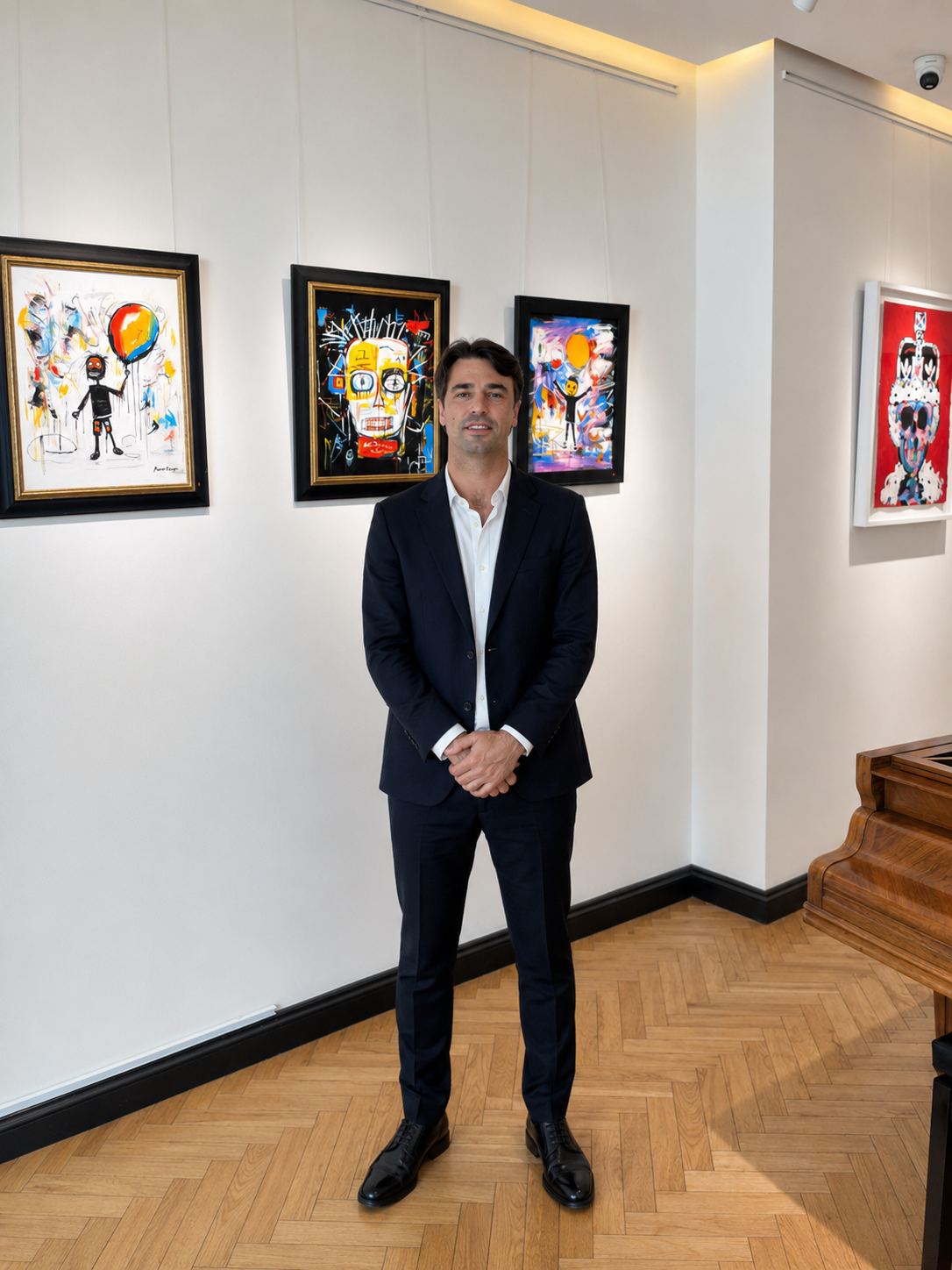
The Asset Broker in the Gallery: Francis Willson on Art, Gold, Global Volatility and the New Collector Mindset
A one-to-one conversation with London Art Exchange’s new Senior Art Advisor and Consignment Manager
By David Maguire
There are people who arrive in the art world through academia, others through aesthetics, and then there are those who arrive through instinct — through the feel of an object in the hand, the quiet logic of scarcity, the client sitting opposite them, and the question that always follows anything rare: why this, and why now?
Francis Willson belongs to the latter camp.
We meet at London Art Exchange’s New Cavendish Street gallery in Marylebone, a space that feels deliberately removed from the theatrics of the traditional white-cube gallery. The mood is polished but not precious. There is art on the walls, naturally, but there is also a sense of commerce being conducted properly: private viewings, collector conversations, consignments being assessed, artists being positioned, valuations being discussed with the care of people who know that confidence is built slowly.
Willson has recently joined London Art Exchange as Senior Art Advisor and Consignment Manager, working across LAX.art and LAX.bid. His arrival feels timely. The art market is moving through one of its more complicated chapters: global sales have begun to recover after two years of decline, with Art Basel and UBS reporting a 4% rise in global art sales to an estimated $59.6 billion in 2025, while public auction sales rose 9% to $20.7 billion. Yet this is not a euphoric market. It is selective, educated, and much less forgiving of weak narratives.
That suits Willson.
His career began far from the gallery floor. At 16, he was working in his uncle’s business in Hatton Garden, London’s historic jewellery district. There, before he had even fully entered adulthood, he was learning the language of diamonds, watches, rare jewellery, condition, authentication, and client trust. By 20, he had joined a specialist collectibles consultancy working across fine art, gold, watches, diamonds, sports memorabilia and wider collectible markets. Somewhere between the logic of precious stones and the theatre of cultural objects, fine art took hold.
Today, he owns and curates a personal collection of more than 50 artworks. He has travelled extensively across Europe, North America, Asia, Africa and beyond, visiting galleries, museums, auction houses and cultural institutions. He is also a Level 4 Qualified Financial Adviser, having advised more than 700 private clients across collectible assets and a further 50 clients within traditional financial services.
That combination — luxury asset knowledge, advisory discipline, and genuine collecting instinct — is what makes him interesting.
“I think the worst mistake you can make,” Willson says, settling into a chair at the gallery, “is to treat art as just another product. It isn’t. But the second worst mistake is to pretend there’s no commercial logic to it. Serious collectors understand both sides.”
London Art Exchange’s own internal operating philosophy reflects that balance: the company trains staff to speak about both cultural value and commercial value, while avoiding lazy assumptions, checking facts, and never turning sales language into guarantees.
David Maguire: You came into this world through Hatton Garden rather than art school. Does that change the way you look at art?
Francis Willson: Definitely. Hatton Garden teaches you respect for detail very early. With watches, diamonds and jewellery, you learn that value is never just about the object. It is condition, scarcity, provenance, timing, demand, trust and the person presenting it. Art is different emotionally, but the principles of confidence are very similar.
I came into fine art through the broader luxury asset market, so I am naturally interested in why certain objects hold attention over time. A collector doesn’t just buy paint on canvas. They buy authorship, story, placement, rarity, documentation and, sometimes, a place in an artist’s wider market journey.
David Maguire: The market feels uncertain. Equities are volatile, digital assets have had cycles of extreme enthusiasm and extreme repricing, gold has moved strongly, and collectors are more cautious. What are you seeing?
Francis Willson: I think the word is discipline. A few years ago, people were buying into almost anything with momentum. Now they are asking better questions. Who is the artist? What is the story? Is there supply control? Is there institutional or gallery support? Is there collector demand beyond hype? Can I see comparables? Can I understand the exit route if I ever choose to sell?
The wider financial environment has changed the psychology. When people see digital markets move violently, or they see currencies and debt levels under pressure, tangible assets become more attractive. But that does not mean you can be lazy. Gold and art are both tangible, but they behave very differently.
David Maguire: Let’s talk about gold versus art. You have experience across both. How do you compare them?
Francis Willson: Gold is the great macro asset. It is liquid, globally understood, and it reacts to fear, currency pressure, central bank behaviour and geopolitical risk. The World Gold Council tracks gold price data across currencies back to 1978, and its current data shows how central it remains to global price discovery.
Art is more nuanced. It is less liquid than gold, but that is part of its character. A painting by the right artist is not interchangeable in the way bullion is. It has authorship. It has cultural identity. It has scarcity that cannot simply be mined or minted. The right artwork can sit in a room and carry emotional, social and financial meaning at the same time.
David Maguire: You’ve spoken before about luxury assets forming part of a modern portfolio. Some people say 15% is the number. Do you agree?
Francis Willson: I would be careful with blanket statements because every client is different. But, as a broad conversation, I do think many sophisticated clients should at least discuss whether a measured allocation to tangible luxury assets makes sense — and for some, that might be up to around 15% across categories like art, gold, watches or other collectibles.
But it has to be suitable. It has to be understood. It has to be documented. And clients should always take independent financial, legal or tax advice where needed. Art is not regulated like a financial product, and values can go down as well as up. That has to be said clearly.
David Maguire: That sounds more restrained than the typical “alternative investment” pitch.
Francis Willson: It has to be. If someone tells you art is guaranteed, they are either inexperienced or being reckless. What we can talk about is historical price movement, scarcity, demand, artist development, provenance and market positioning. That is very different from promising a result.
London Art Exchange’s compliance framework is explicit on that point: art investment must not be presented as regulated, values must not be described as one-directional, past performance must be balanced, and language such as “guaranteed returns,” “safe investment,” “secure returns,” “fixed growth,” or “wealth protection” should not be used.
David Maguire: The Middle East — especially Abu Dhabi — was becoming one of the major art-market conversations. Then geopolitics shifted. What happens now?
Francis Willson: Abu Dhabi is still hugely important. The infrastructure is real. Louvre Abu Dhabi is already established, teamLab Phenomena opened in 2025, Zayed National Museum has been part of the cultural build-out, and Guggenheim Abu Dhabi and Frieze Abu Dhabi are part of the wider story of Saadiyat Island becoming a major cultural hub.
But conflict changes behaviour. It affects logistics, sentiment, travel, insurance and timing. The Gulf art market has clearly felt the force of Middle East geopolitical stress, and that has made some collectors more cautious.
The important point is that caution is not the same as disappearance. Serious collectors do not stop collecting because the world becomes uncertain. They become more selective. They want stronger stories, stronger documentation and better advice.
David Maguire: Where does London sit in that?
Francis Willson: London still matters because it is trusted. It is international, but it is also discreet. For Middle Eastern, Asian, American and European collectors, London remains a place where art, finance, law, luxury and culture overlap. That is why a gallery like LAX, with physical presence, advisory, consignment, auction access and online reach, is well placed.
David Maguire: Who is the hottest artist you are working with at the moment?
Francis Willson: Mr Phantom is the artist everyone wants to talk about.
He has that rare combination of cultural charge and market intrigue. He is anonymous, socially conscious, visually direct, and the work has a message. It is not decorative street art. It is political, psychological and very aware of the world we are living in.
The £147,000 sale of The Matrix in London was a major marker for his market, especially because it reportedly exceeded the high estimate by 40%. But again, that is not a guarantee of future performance. It is a comparable. It gives collectors a reference point.
David Maguire: What makes Mr Phantom different from other contemporary artists?
Francis Willson: He understands the moment. We are living in a world of surveillance, digital identity, conflict, social anxiety, political theatre and collapsing trust. Phantom speaks to that. Collectors are not just buying an image; they are buying into a conversation.
And his work has range. There is the public-facing, socially charged side, but also the studio practice, the collector works, the editions, the philanthropic dimension, the Mind Charity connection and the cultural stunts. He behaves like an artist who understands the age he is working in.
David Maguire: And Gabrielle Malak?
Francis Willson: Gabrielle Malak is very different. He is a French-Moroccan contemporary painter from Marseille whose work is rooted in portraiture, emotion and cultural memory. His paintings have that cinematic atmosphere — colour, intimacy, femininity, travel, beauty, strength. London Art Exchange describes his practice as exploring emotional and cultural multiplicity, especially through female portraiture.
Malak works beautifully for private collectors, interiors, corporate spaces and people who want an artwork with elegance but also depth. He has wall power. You can place a Malak in a serious home or office and it changes the room.
David Maguire: Pierre Simone seems to sit somewhere else again.
Francis Willson: Pierre is rawer, more explosive. He is a multidisciplinary artist from Haiti, and his work blends neo-expressionism, cultural storytelling and symbolic vocabulary. His paintings move between chaos and clarity, and that tension is what makes them exciting.
He suits collectors who like energy, identity, rhythm, colour, urban influence and emotional honesty. With Pierre, you feel the work before you analyse it.
David Maguire: You talk a lot about supply and demand. Is that still the core of the art market?
Francis Willson: It is the core of every market, but art makes it more interesting. Supply is not just quantity. It is controlled release, the number of originals, whether an artist is overproducing, whether the best works are being held, whether collectors are keeping works off market, and whether the gallery is building the artist properly.
Demand is also layered. You have aesthetic demand, cultural demand, investment-led demand, institutional demand, interior demand and social demand. The best artists can sit across more than one.
David Maguire: You mentioned GDP earlier in our conversation. What does macro growth have to do with art?
Francis Willson: It gives context. Global GDP in current US dollars was about $111 trillion in 2024, according to World Bank data via FRED. The world has expanded enormously over the past 25 years. There is more wealth, more liquidity, more family-office activity, more global mobility and more competition for scarce cultural assets.
But GDP growth alone does not make an artist valuable. What it does is create more buyers capable of competing for a finite number of serious works. That is where scarcity becomes interesting.
David Maguire: Where do you see the market going in the next couple of years?
Francis Willson: I think the easy market is gone, and the educated market is here. Collectors will want evidence. They will want provenance. They will want artists with clear narratives. They will want works that can survive beyond a trend.
The middle of the market is interesting because it is accessible enough for new serious collectors but still meaningful enough for experienced buyers. The top end has become more selective. The lower end is crowded. The intelligent space is where quality, scarcity, artist story and price discipline meet.
David Maguire: What does Francis Willson bring to London Art Exchange that is different?
He pauses for the first time.
Francis Willson: I understand the client who thinks commercially, because I have sat in financial-advice conversations. I understand the client who loves beautiful objects, because I grew up around watches, diamonds and jewellery. And I understand the collector, because I am one.
My job is not to force people into art. My job is to understand what they are trying to achieve — buying, selling, exchanging, consigning, building a portfolio, creating a legacy, or simply learning the market properly — and then guide them clearly.
That clarity may be Willson’s greatest asset. Not the Hatton Garden story. Not the financial qualification. Not the private collection. Not the 700 clients advised across collectible assets. It is the way he speaks about art without stripping it of romance, and about money without pretending it is magic.
In a market full of noise, Francis Willson’s pitch is unusually simple: understand the object, understand the client, understand the risk, and never confuse hype with value.
For London Art Exchange, that may be exactly the kind of advisor the next phase of the market requires.
Publication disclaimer: This article is for editorial and informational purposes only. It does not constitute financial, legal, tax, or investment advice. Art is an unregulated market; values can go down as well as up, and past performance is not a reliable indicator of future results.